
AI Insights · Yuwen Huang · June 2026
State of AI 2026: Competition, Commerce, and the New Digital Economy
Sensor Tower’s State of AI 2026 report explores how Generative AI is reshaping competition, consumer behavior, and monetization across mobile, web, and digital advertising.
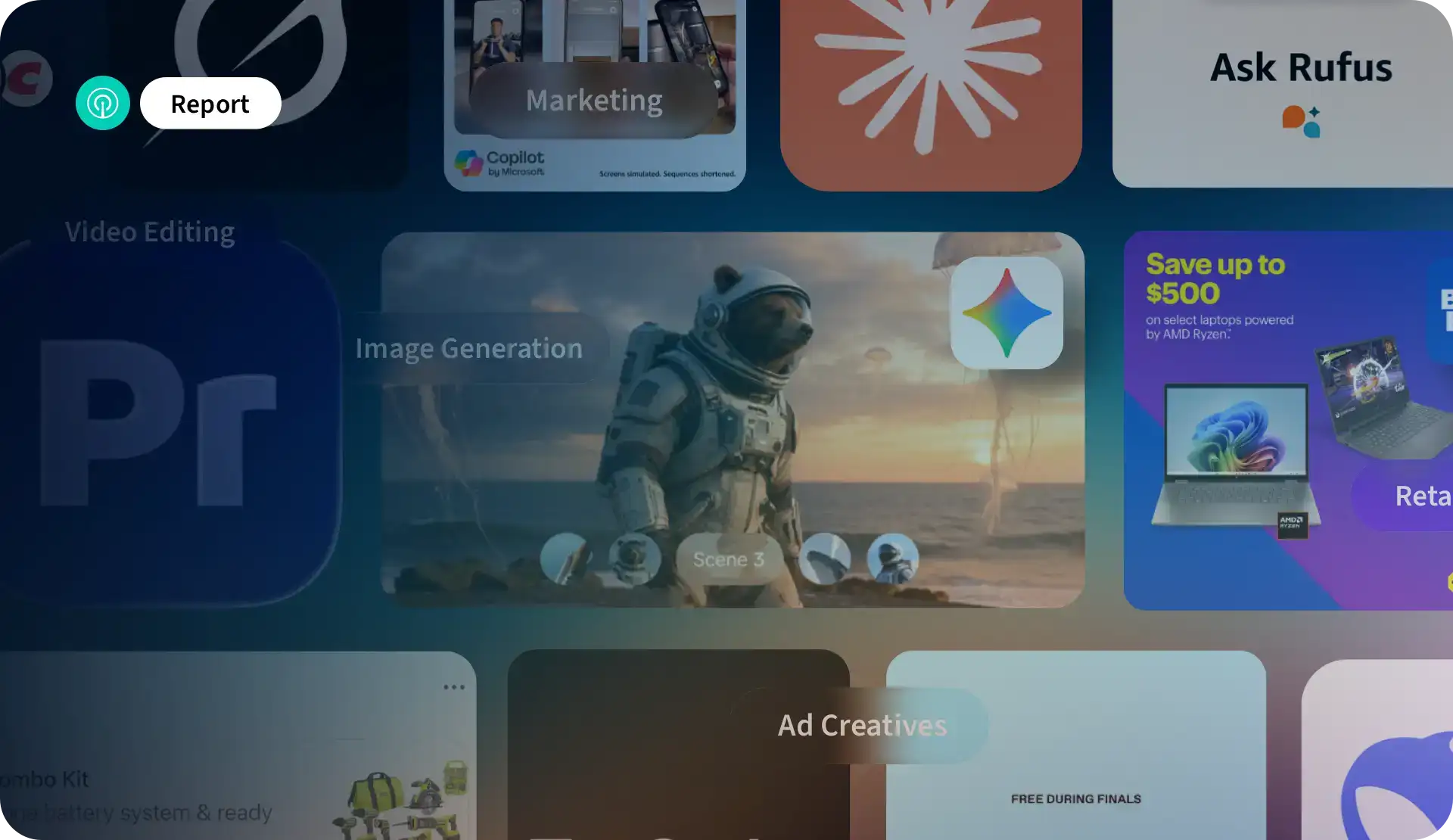
What began as a chatbot-led shift in 2023 has now evolved into a broader ecosystem transformation, spanning AI assistants, AI-powered shopping, and the rapid expansion of AI messaging across advertising and non-AI apps.
Across mobile and web ecosystems, three major stories define the state of AI in 2026:
Rivals look to challenge ChatGPT
AI agents are changing how people shop
AI is becoming the new place for discovery — and ads
Sensor Tower’s State of AI 2026 report dives into these topics and more, covering the latest trends across devices and verticals.
Rivals Look to Challenge ChatGPT
ChatGPT continues to define the AI assistant category, becoming the fastest mobile app ever to reach one billion monthly active users in May 2026—achieving the milestone in just three years, faster than TikTok, YouTube, and Instagram.
Despite the rise of new competitors, the market remains highly concentrated. ChatGPT, Google Gemini, and DeepSeek account for nearly 90% of total time spent across AI assistant apps in Q1 2026, underscoring the continued dominance of a small number of platforms.
However, competition is beginning to intensify at the margins of this concentrated market. ChatGPT’s True Audience share, measuring unique users across mobile apps and web, fell below 50% for the first time in March 2026 as Google Gemini and Claude gained traction across key global markets. Google Gemini has steadily expanded its footprint, particularly across Europe, the US, Japan, and South Korea, supported by strong Android integration and broader ecosystem distribution across Google's services.
Claude has emerged as the fastest-growing challenger in 2026, with True Audience up 452% YoY in May and US market share rising from 4.4% to nearly 14% over the same period. In the United States, ChatGPT uninstalls surged following OpenAI's agreement with the Department of War, peaking at roughly 200% above the app's average during the week of March 9–15. Many users who uninstalled ChatGPT appeared to switch to Claude, following Anthropic's decision to decline a partnership with the Pentagon. Claude recorded more daily downloads than ChatGPT from March 1–5. ChatGPT has led on each day since, though the gap remains much narrower than it was before March.
While ChatGPT remains the clear category leader, the data signals a gradual shift from a single-dominant-player market toward a more competitive multi-player landscape, driven largely by Gemini’s structural reach and Claude’s rapid adoption among professional and high-intent user segments.
AI Agents Are Changing How People Shop
AI assistants are increasingly influencing how consumers discover and evaluate products online, particularly in research-heavy categories like electronics, home goods, and fashion. GenAI referral traffic to shopping sites increased across all major retail categories between Q4 2024 and Q1 2026. Computers & Consumer Electronics led the shift, with GenAI’s share of traffic rising nearly fourfold, while Home & Garden and Sports & Outdoors both exceeded 0.35% of total visits.
However, adoption is not evenly distributed. Retailers like Walmart and Target, both integrated with AI assistants, have seen GenAI referral shares rise above 1.5%, while Amazon remains lower due to limited crawler access and a more closed ecosystem approach.
Early agentic shopping systems such as Amazon’s Rufus and Walmart’s Sparky are also reshaping on-platform behavior. Rufus users convert at nearly twice the rate of non-users, while Sparky adoption has grown rapidly alongside increased engagement time and reported higher order values.
This suggests AI is not only driving traffic externally, but also increasing conversion efficiency and session depth within retail ecosystems.
AI Is Becoming the New Place for Discovery — and Ads
As AI adoption expands, it is becoming a new discovery layer across digital ecosystems, alongside Search and Social. ChatGPT began testing ads in early 2026, and by May, ad impressions had increased more than 7x since March. While overall penetration remains low, AI platforms are quickly evolving into a new performance and discovery channel for advertisers.
Early advertisers are concentrated in Shopping, Software, Travel, and Financial Services, reflecting AI’s strength in research-heavy decision journeys. However, restrictions in sensitive categories such as healthcare and gambling are shaping a more curated advertising ecosystem compared to traditional social platforms.
At the same time, AI brands themselves are becoming major advertisers. Spending on GenAI-related advertising more than tripled in the US in Q1 2026, with OpenAI and Anthropic increasing spend by 800%+ YoY as competition for users intensifies.
Across the broader internet, AI-related messaging is also becoming mainstream. More than 200,000 apps now mention AI in their descriptions, and ad creatives mentioning ¸ generated over $1.3 billion in spend globally in Q1 2026.
The Bigger Picture
Across assistants, commerce, and advertising, a consistent pattern is emerging:
AI is no longer a standalone category—it is becoming a behavioral and commercial layer across the internet.
In assistants, the market is shifting from dominance to competition
In commerce, AI is reshaping discovery and conversion
In advertising, AI is becoming both a medium and a message
Across apps, AI is becoming a default feature rather than a product
Together, these shifts suggest that 2026 is the year AI transitions from early adoption to structural integration across the digital economy.
Additional Highlights:
Read Sensor Tower’s State of AI 2026 report, covering:
GenAI Market Landscape: Global time spent on GenAI apps projected to reach 36 billion hours in H1 2026, up from 17.2 billion hours in H1 2025.
AI Consumer Behavior: ChatGPT engagement reached ~215 minutes per user per month, while Gemini (+14 → 100 minutes) and Claude (+40 → 120 minutes) saw rapid gains in usage intensity.
GenAI Marketing: GenAI ad spend more than tripled in the US in Q1 2026, led by OpenAI (+800% YoY) and Anthropic (+1,184% YoY) as competition for users intensified.
AI Across Verticals: Apps mentioning AI-related terms are on track for nearly 10 billion downloads in H1 2026, with adoption expanding across Health & Wellness, Finance, Education, and Utilities.
Advertising Trends Across Verticals: AI-related advertising reached $1.3B in spend and 167B impressions in Q1 2026, with Health & Wellness leading growth at +165% YoY.
Download the full report to explore the data shaping the next phase of the AI economy.