
Mobile App Insights · Digital Advertising Insights · Web Insights · Donny Kristianto · July 2026
State of Digital Banking 2026
Discover how digital banking apps are reshaping financial services across downloads, engagement, audience behavior, and advertising, with insights into leading markets, high-growth digital banks, incumbent app refreshes, and the ecosystem strategies defining mobile banking in Sensor Tower’s State of Digital Banking Apps 2026 report.
Digital banking has become a mainstream part of everyday financial activity, giving consumers faster and more convenient access to accounts, payments, transfers, and other services while helping banks expand reach and operate more efficiently. As adoption deepens, global banking website visits have declined, driven largely by lower desktop traffic, while mobile web’s share has risen to around 40%. Even within browser-based banking, consumers are increasingly accessing services through mobile devices.
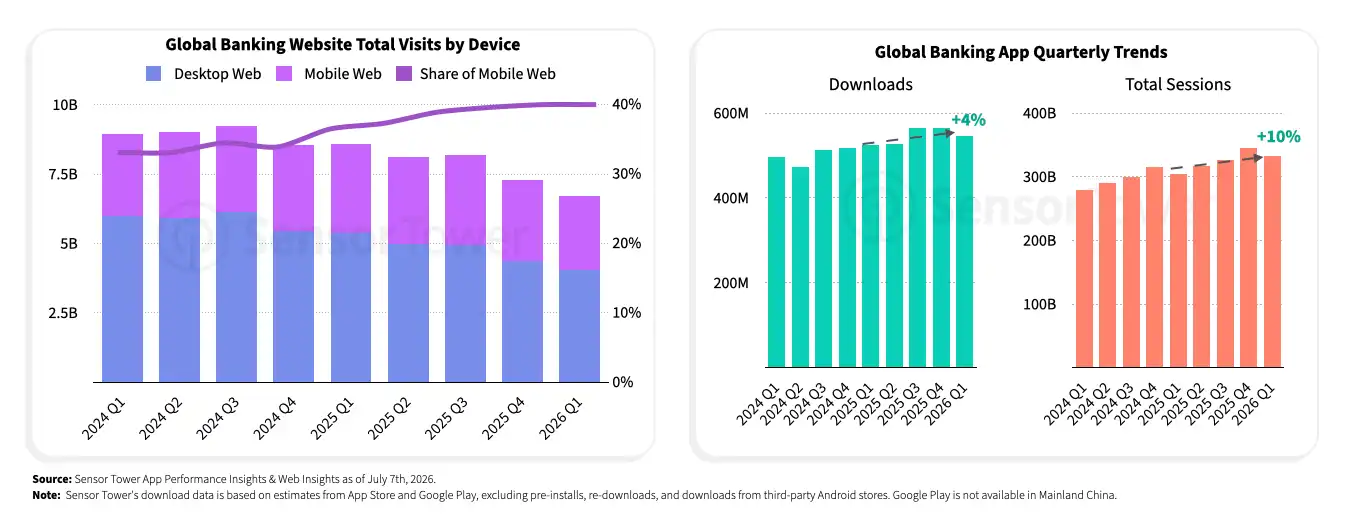
This broader shift toward mobile access is also evident in app adoption and usage. Mobile banking continued to expand in Q1 2026, with quarterly downloads remaining above half a billion and increasing 4% year over year. Engagement grew even faster, as total sessions rose 10%, showing that consumers are not only adopting banking apps at scale but also using them more frequently for everyday financial activities.
Among apps in the broader Financial Services category, banking remained the largest segment in the 12 months ending May 2026, generating approximately 2.3 billion downloads, up 7% year over year. Other mobile financial segments have grown around specific utilities—such as wallets for payments, lending for credit, and investing for wealth creation—but banking remains the foundation for accounts, deposits, savings, transfers, and everyday money management.
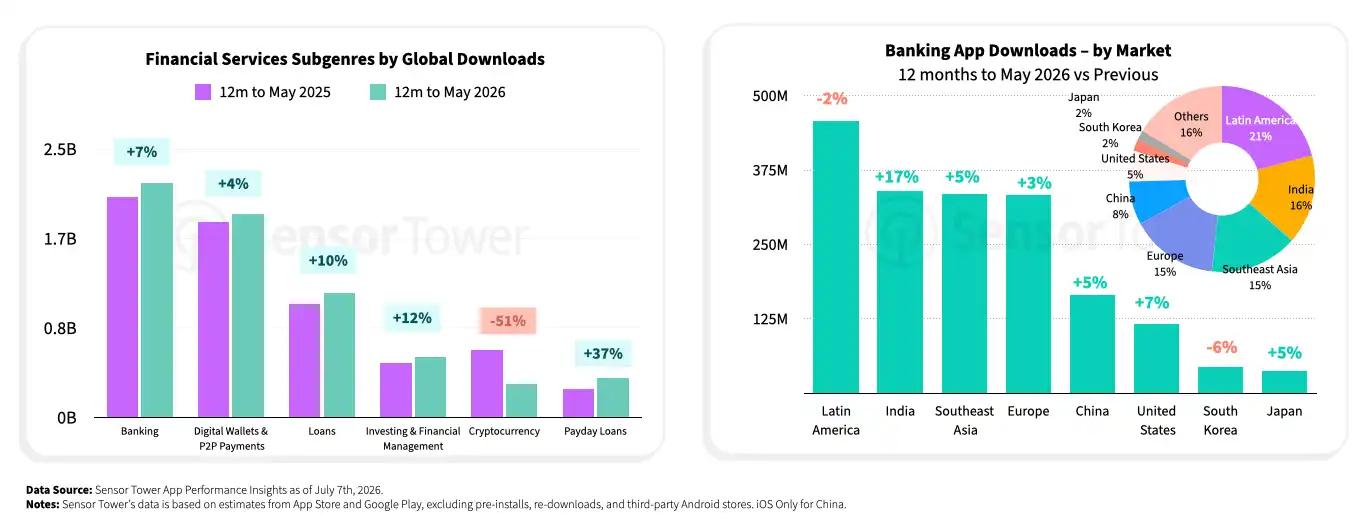
Latin America remained the largest market for banking app downloads, accounting for 21% of the global total despite a 2% year-over-year decline. India posted the strongest growth among major markets at 17%, while Southeast Asia and Europe also expanded. The results reflect growing adoption across both traditional bank apps and digital-first banking models, particularly in large, mobile-first economies.
To explore how digital banking is reshaping the global financial services landscape — and which markets, banking models, engagement trends, and advertising strategies are driving the sector’s next phase of growth — download the full State of Digital Banking 2026 report.
Note: The download data in this report are based on estimated downloads from the App Store and Google Play, excluding pre-installs, re-downloads, and downloads from third-party Android marketplaces. For more insights, please click the button below to view the full report for free.
Neobank and Traditional Banks Are Competing for Mobile Banking Leadership
As consumers increasingly manage their finances through apps, competition is consolidating around two broad banking models. Digital banks and neobanks are entering with branchless, mobile-first propositions, while traditional institutions—including incumbent banks, their digital-only brands, and postal, cooperative, and specialist banks—are modernizing established services for app-based delivery.
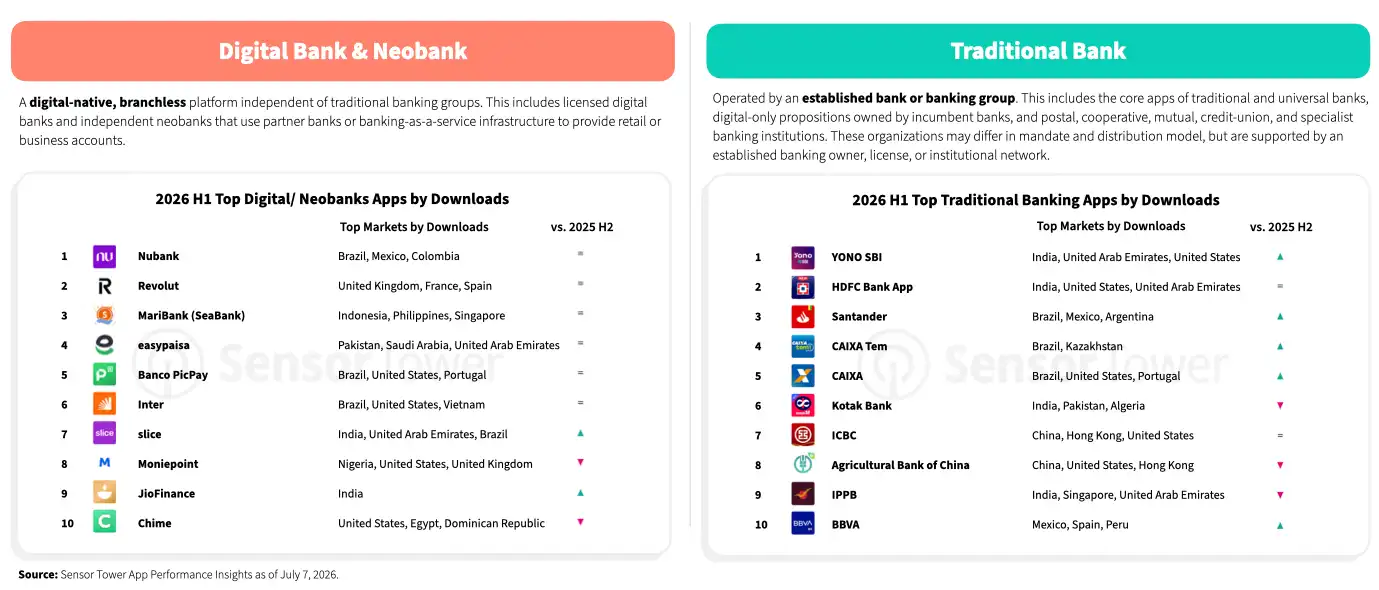
Despite their different ownership and operating structures, both groups are competing on the same priorities: convenience, trust, and everyday customer engagement.
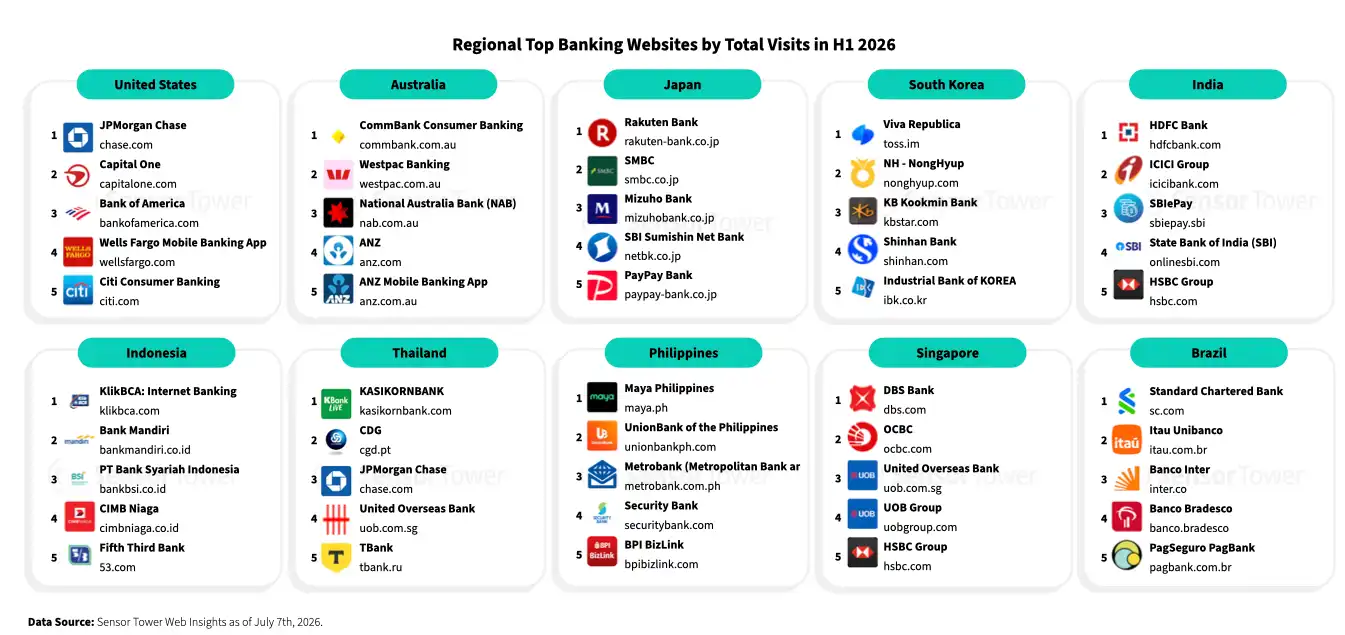
Even as Banking Moves Mobile, Traditional Leaders Continue to Dominate Web Traffic
Banking website traffic remains highly localized, with established domestic institutions occupying most top positions across major markets. Traditional leaders such as Chase, CommBank, SMBC, HDFC Bank, DBS, and BCA continue to benefit from strong brand recognition, broad product portfolios, and long-standing customer relationships. Digital-first brands have nevertheless broken into the leading ranks in select markets—most notably Toss in South Korea, Maya in the Philippines, and Rakuten Bank in Japan—showing that web leadership can also emerge where newer players build strong local relevance and differentiated digital propositions.
Neobank Challengers Gain Ground Through Mobile-First Expansion, While Traditional Banks Retain Scale
Nubank remained the world’s most downloaded core banking app in H1 2026, followed by Revolut and MariBank / SeaBank. Digital banks and neobanks accounted for several of the leading download positions, reflecting strong mobile-first adoption across Latin America, Europe, and Southeast Asia. Traditional banks such as YONO SBI, HDFC, Santander, CAIXA Tem, and CAIXA also retained meaningful scale, showing that incumbent banks continue to command large mobile audiences in their home markets.
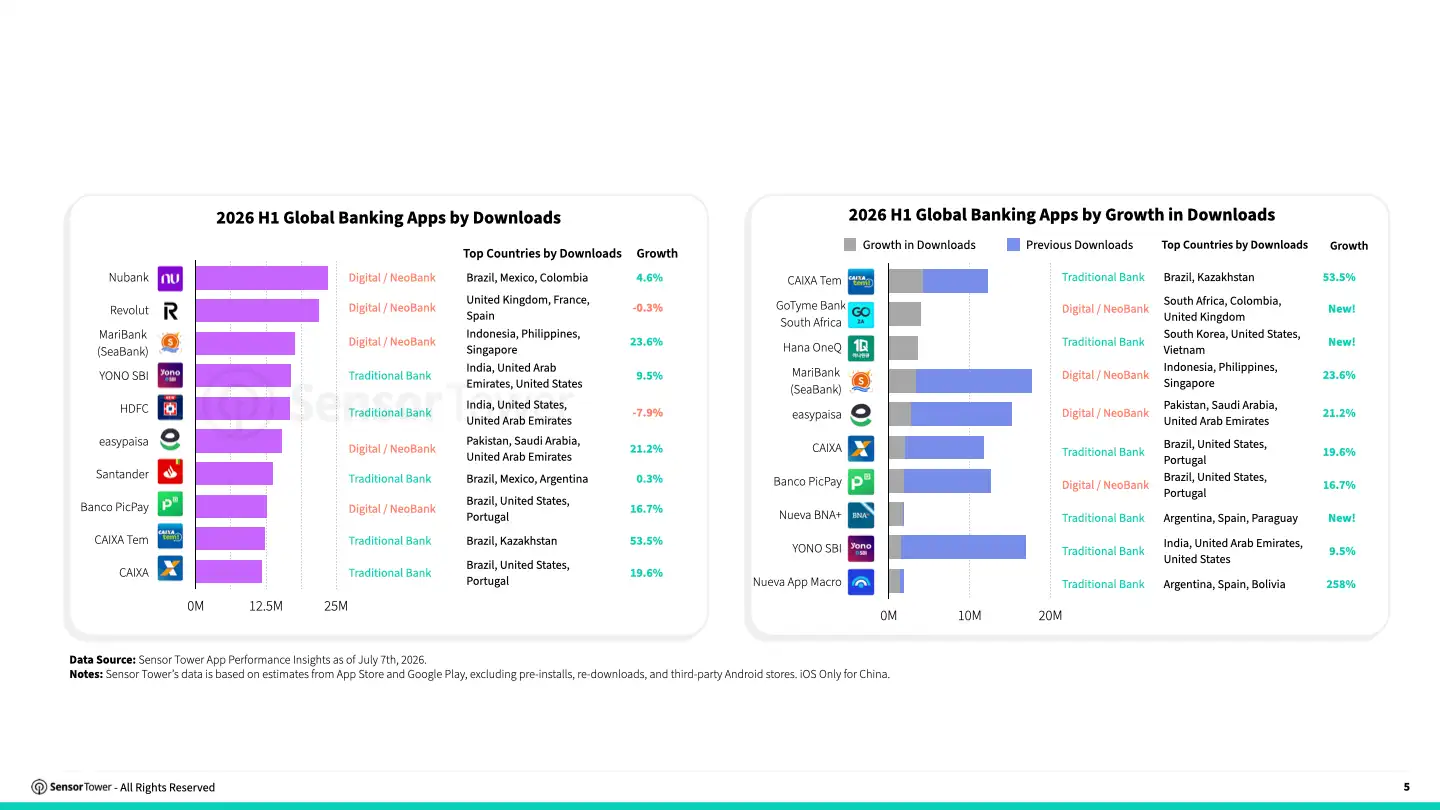
Growth was distributed across both digital challengers and traditional banks. CAIXA Tem led the ranking with 53.5% growth, while MariBank / SeaBank, easypaisa, Banco PicPay, CAIXA, and YONO SBI also posted strong gains. New entries such as GoTyme Bank South Africa, Hana OneQ, and Nueva BNA+ highlight how refreshed propositions and expanding digital banking services can quickly gain traction, reinforcing that growth is not limited to neobanks alone but also available to incumbents modernizing their mobile experiences.
Neobanks Build Trust as Traditional Banks Reinvent the Digital Experience
Neobanks are increasingly addressing one of their biggest adoption barriers: consumer trust. Brands such as Chime and Nubank are emphasizing security controls, real-time alerts, responsive customer support, and access to human assistance—helping reassure users that a digital-first bank can provide the reliability and protection traditionally associated with established institutions.
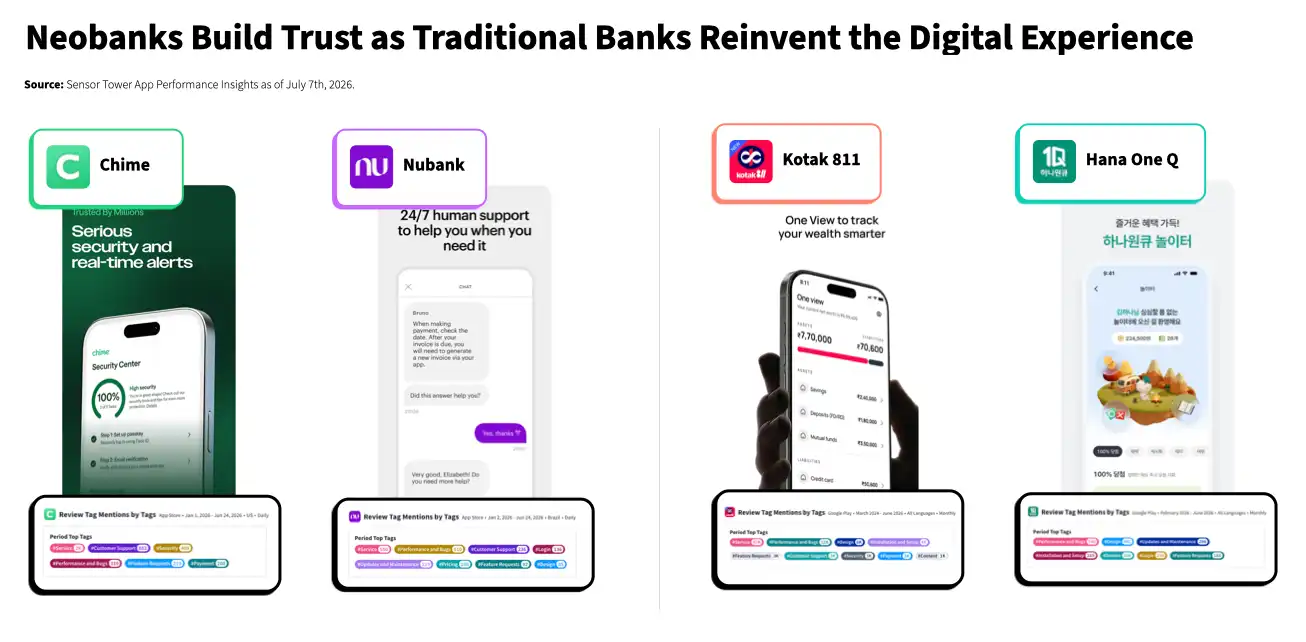
Traditional banks, meanwhile, are responding by modernizing the mobile experience. Relaunched apps such as Kotak 811 and Hana OneQ focus on cleaner interfaces, consolidated account views, easier navigation, and more engaging features. By combining long-standing brand credibility with neobank-style design and usability, incumbents can strengthen digital engagement while remaining competitive with mobile-first challengers.
Consumer Banking Ad Impressions Top 50B as Quarterly Ad Spend Remains Above $350M
Consumer banking advertising reach expanded steadily from 2024 through early 2026, with quarterly impressions rising from roughly 35 billion to more than 52 billion. Impressions have remained above 50 billion since Q3 2025, highlighting sustained efforts by banking brands to broaden visibility and compete for consumer attention.
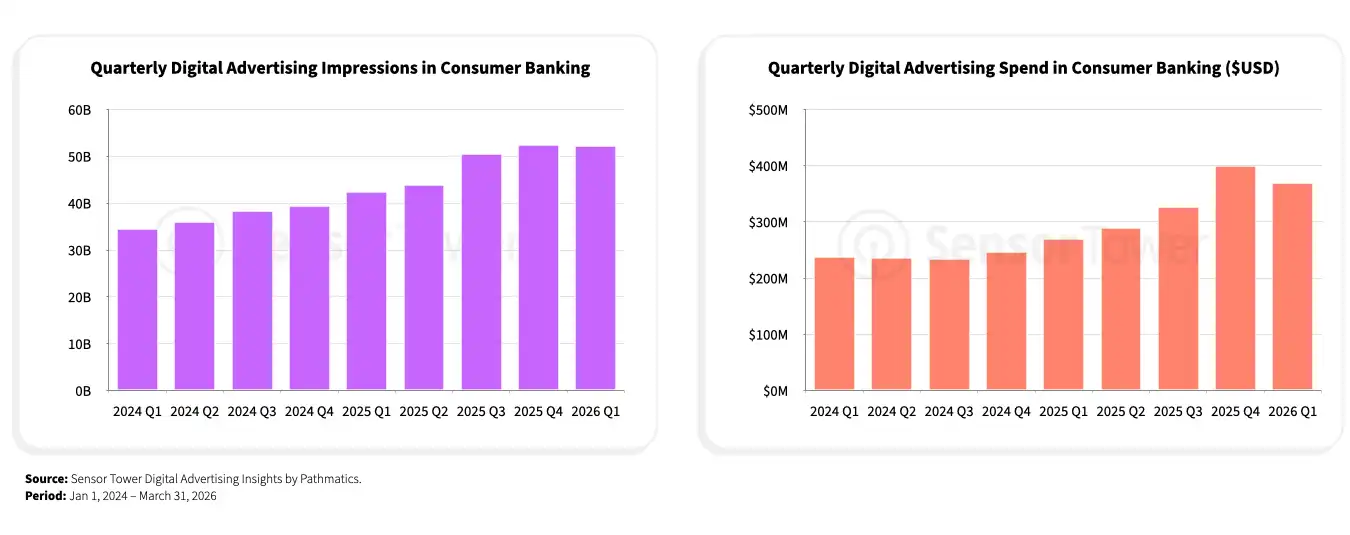
Digital ad spend also increased, rising from approximately $240 million in Q1 2024 to nearly $370 million in Q1 2026, after peaking at around $400 million in Q4 2025. The continued elevation in spend suggests that banks are maintaining significant investment even after the year-end advertising surge.
Case Study: How Shopee’s Ecosystem Helps SeaBank Scale Across Indonesia and the Philippines
SeaBank has become one of Southeast Asia’s fastest-growing digital banking brands, supported by close integration with Sea Limited’s broader consumer ecosystem. By connecting banking services with Shopee’s large user base, payments activity, and promotional reach, SeaBank has built a scalable acquisition model across Indonesia and the Philippines, while operating as MariBank in Singapore.
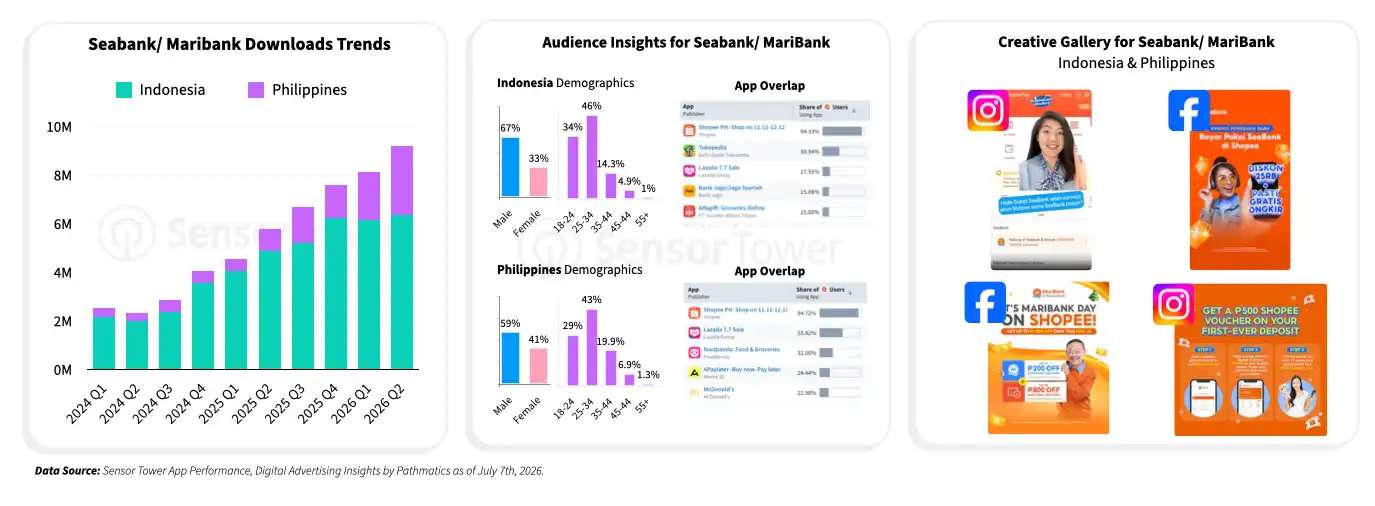
SeaBank’s combined quarterly downloads rose from around 2.6 million in Q1 2024 to more than 9 million by Q2 2026. Indonesia remained the largest contributor, while the Philippines delivered increasingly strong incremental growth, helping sustain the brand’s regional expansion. SeaBank attracts a predominantly young, digitally active audience, with users aged 18–34 accounting for the majority in both markets. Shopee records by far the highest app overlap, reaching more than 94% of SeaBank users, while Lazada, Tokopedia, food delivery, and flexible-payment apps also feature prominently.
SeaBank’s social advertising consistently links banking benefits to the Shopee shopping experience. Promotions centered on cashback, vouchers, first-deposit rewards, and seasonal campaigns position the bank as an extension of everyday e-commerce activity, helping turn shopping incentives into account acquisition and transaction growth.
Download the full State of Digital Banking 2026 report for deeper insights into the markets, banking models, and strategies driving the sector’s next phase of growth.
Looking Ahead: Digital Banking Enters a New Phase of Scale, Trust, and Engagement
As digital banking continues to expand globally, the sector is moving beyond early adoption into a more competitive phase defined by customer engagement, trust, and differentiated market strategies. Growth remains strong across mobile-first markets in Asia, Latin America, and other emerging regions, while mature markets are seeing banks focus more heavily on retention, product depth, and ecosystem integration.
Momentum is likely to favor banks that can balance scalable acquisition with deeper customer relationships. Digital banks are using rewards, payments, credit, and everyday lifestyle partnerships to become more embedded in consumers’ financial routines, while traditional banks are refreshing their mobile experiences to improve usability, security, and engagement. Advertising remains an important tool for awareness and migration, but long-term growth will increasingly depend on trust, convenience, customer support, and the ability to serve more of a user’s financial life through mobile channels.
For a deeper look at global digital banking trends, regional market dynamics, audience engagement, leading banking models, and the strategies shaping the sector’s next phase, download the full State of Digital Banking 2026 report below.
