
Digital Advertising Insights · Donny Kristianto · May 2026
Southeast Asia State of Digital Advertising 2026
Explore the market dynamics, seasonal moments, leading advertisers, and creative strategies shaping Southeast Asia’s dynamic digital advertising landscape in Sensor Tower’s Southeast Asia State of Digital Advertising 2026 report.

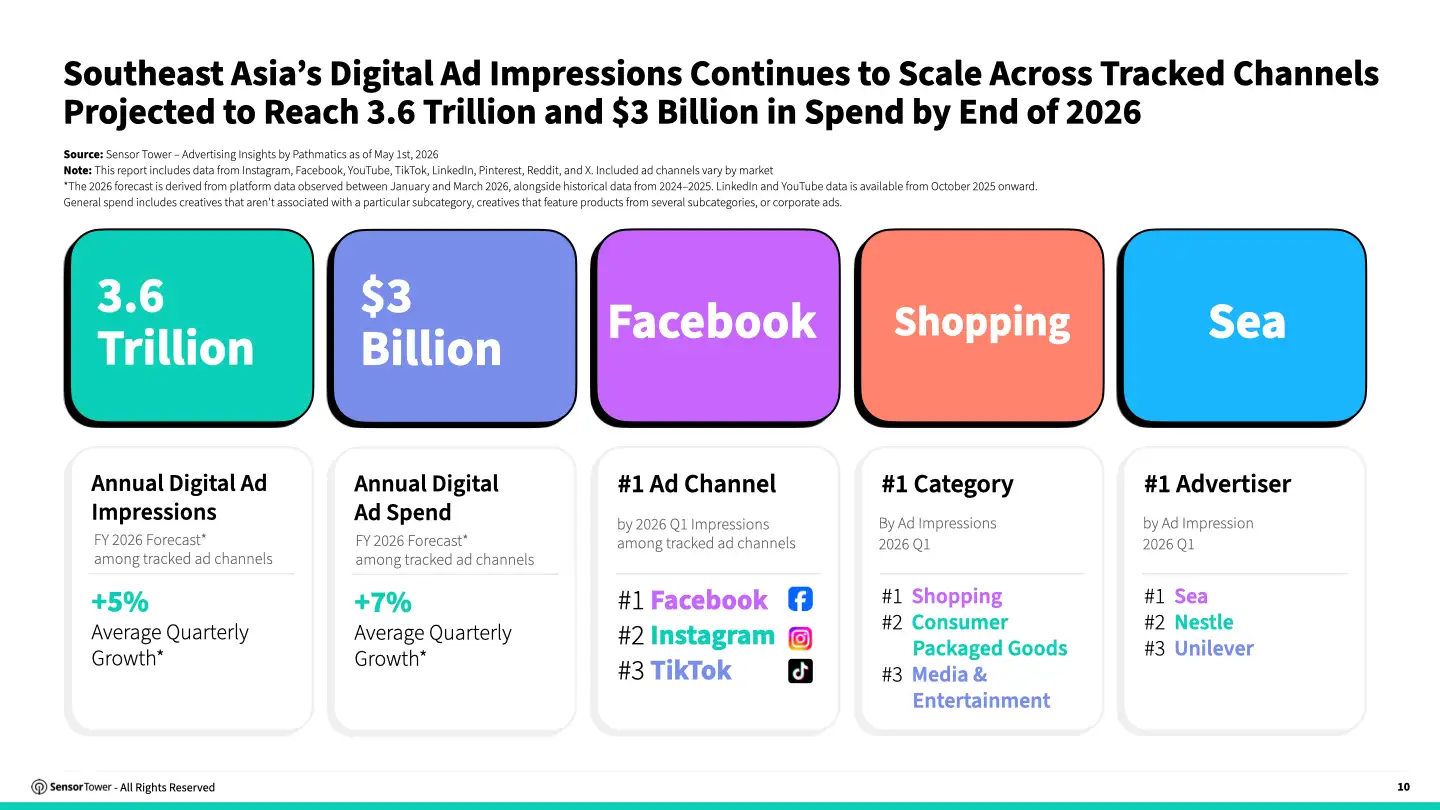
Southeast Asia’s digital advertising market continues to scale across tracked channels, with annual impressions projected to reach 3.6 trillion and digital ad spend expected to surpass $3 billion by the end of 2026. Facebook remained the region’s leading ad channel by impressions in Q1 2026, followed by Instagram and TikTok, while Shopping ranked as the top category and Sea Limited led advertisers by impressions.
To explore how these dynamics are reshaping Southeast Asia’s digital advertising landscape—and which categories, platforms, seasonal moments, and advertisers are driving the next phase of growth—download the full Southeast Asia State of Digital Advertising 2026 report.
Note: The advertising data in this report is based on estimated digital ad spend and impressions from Sensor Tower’s Pathmatics across tracked channels, including Facebook, Instagram, TikTok, YouTube, LinkedIn, Pinterest, Reddit, X, and LINE where available. Channel coverage varies by market.
Please click the button below to view the full report for free.
Southeast Asia’s Digital Advertising Market Continues to Scale
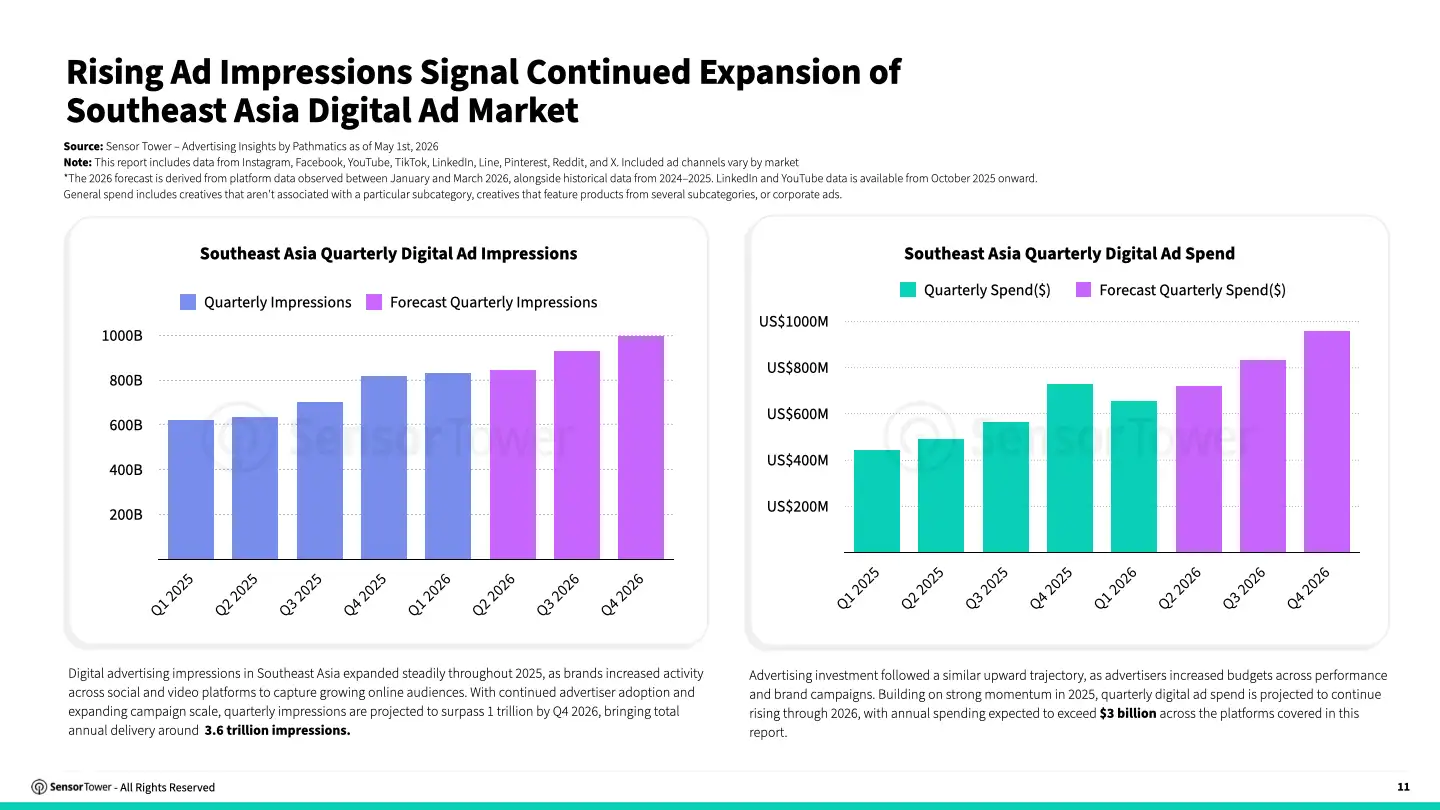
Digital ad impressions in Southeast Asia expanded steadily through 2025 as brands increased activity across social and video platforms to reach growing online audiences. With continued advertiser adoption and expanding campaign scale, quarterly impressions are projected to surpass 1 trillion by Q4 2026, bringing full-year delivery to around 3.6 trillion impressions.
Advertising investment followed a similar trajectory, with quarterly spend expected to continue rising through 2026. This reflects the growing role of digital channels across both performance and brand campaigns, as advertisers compete for attention in one of the world’s most mobile-first consumer regions.
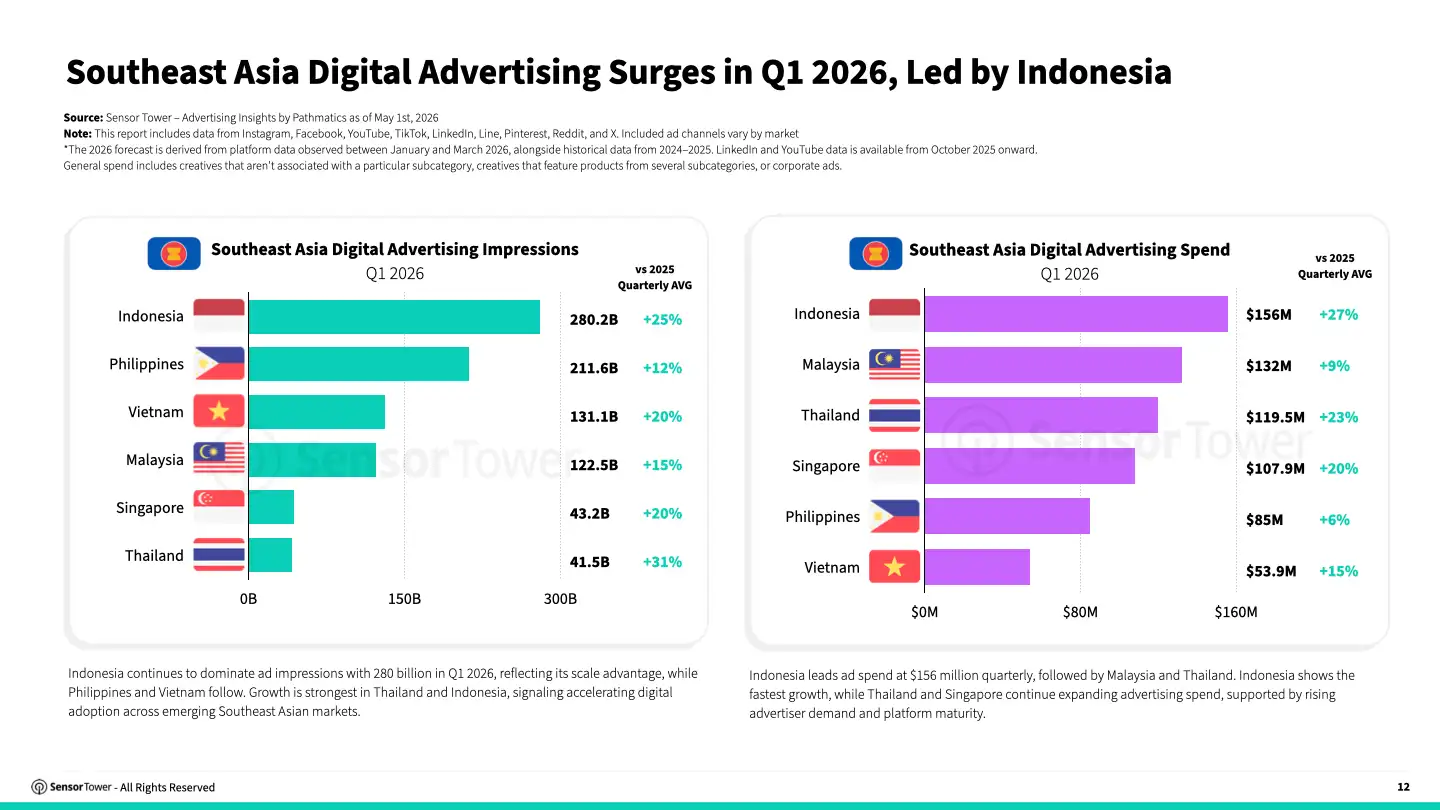
Indonesia remained the region’s largest digital advertising market in Q1 2026, generating 280 billion ad impressions and $156 million in quarterly ad spend, reflecting both scale and strong advertiser momentum. The Philippines and Vietnam followed by impression volume, while Malaysia and Thailand ranked among the next-largest markets by ad spend, underscoring Southeast Asia’s broad-based but highly diverse growth profile.
Indonesia Deep Dive: Digital Advertising Concentrated in Java, with Strong Growth Emerging Beyond Core Regions
In Indonesia, Java dominates ad impressions with over two-thirds share, led by Jakarta at 31%, reflecting its role as Indonesia’s economic and digital hub. While core metros remain stable, cities like Surabaya and Semarang are growing faster, signaling advertiser expansion beyond Jakarta-centric strategies.
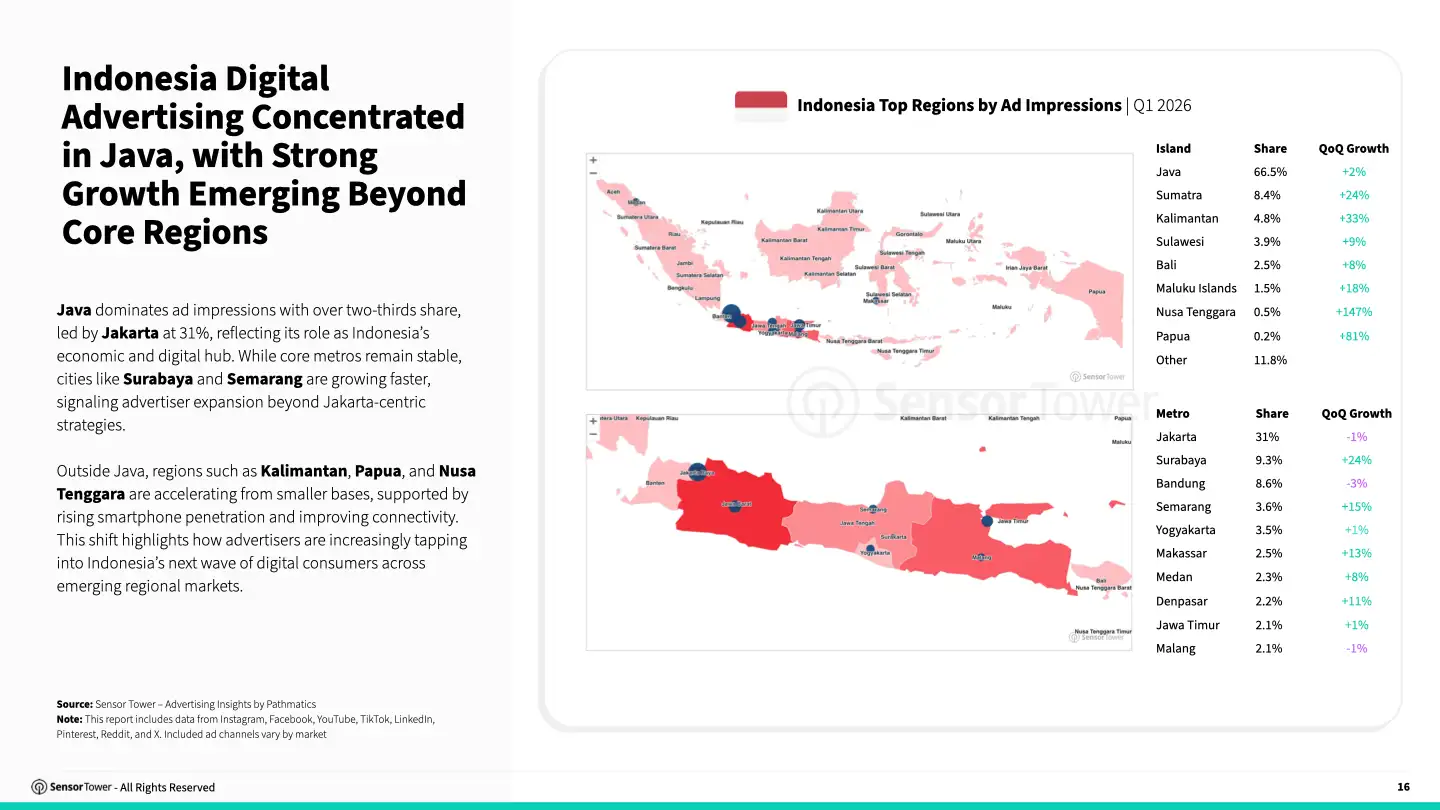
Outside Java, regions such as Kalimantan, Papua, and Nusa Tenggara are accelerating from smaller bases, supported by rising smartphone penetration and improving connectivity. This shift highlights how advertisers are increasingly tapping into Indonesia’s next wave of digital consumers across emerging regional markets.
Shopping and CPG Lead Indonesia Ad Impressions, While AI and Convenience Drive Fastest Growth
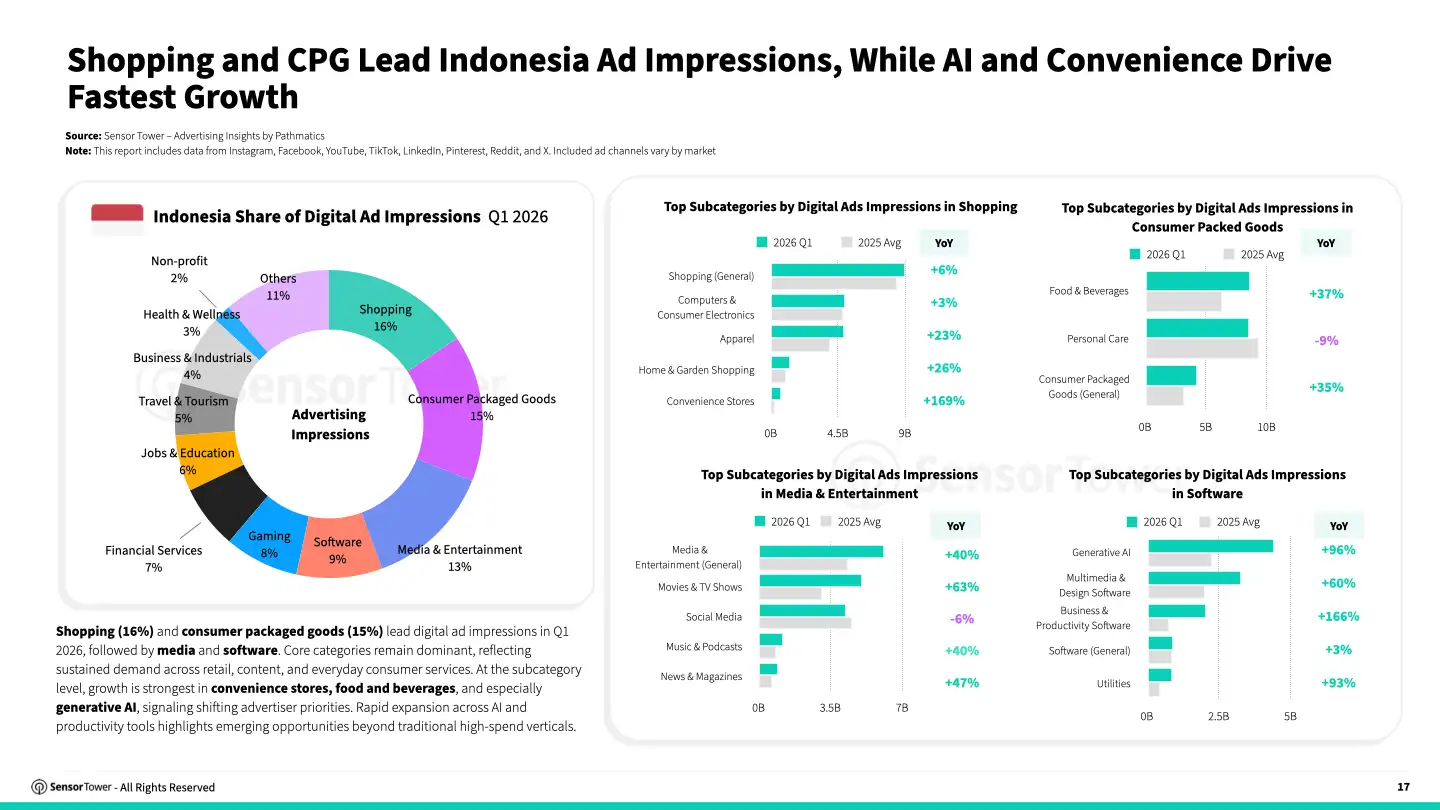
Shopping (16%) and consumer packaged goods (15%) lead digital ad impressions in Q1 2026, followed by media and software. Core categories remain dominant, reflecting sustained demand across retail, content, and everyday consumer services. At the subcategory level, growth is strongest in convenience stores, food and beverages, and especially generative AI, signaling shifting advertiser priorities. Rapid expansion across AI and productivity tools highlights emerging opportunities beyond traditional high-spend verticals.
E-commerce Platforms Lead Ad Impressions as Media and AI Players Rapidly Emerge
Shopping-driven platforms dominate Indonesia’s ad impressions, with Sea Limited and ByteDance maintaining top positions. Their scale reflects the need for sustained, high-frequency campaigns to capture demand in a highly competitive, promo-driven e-commerce landscape, especially during peak moments like Ramadan and major campaign days such as 9.9 and 11.11.
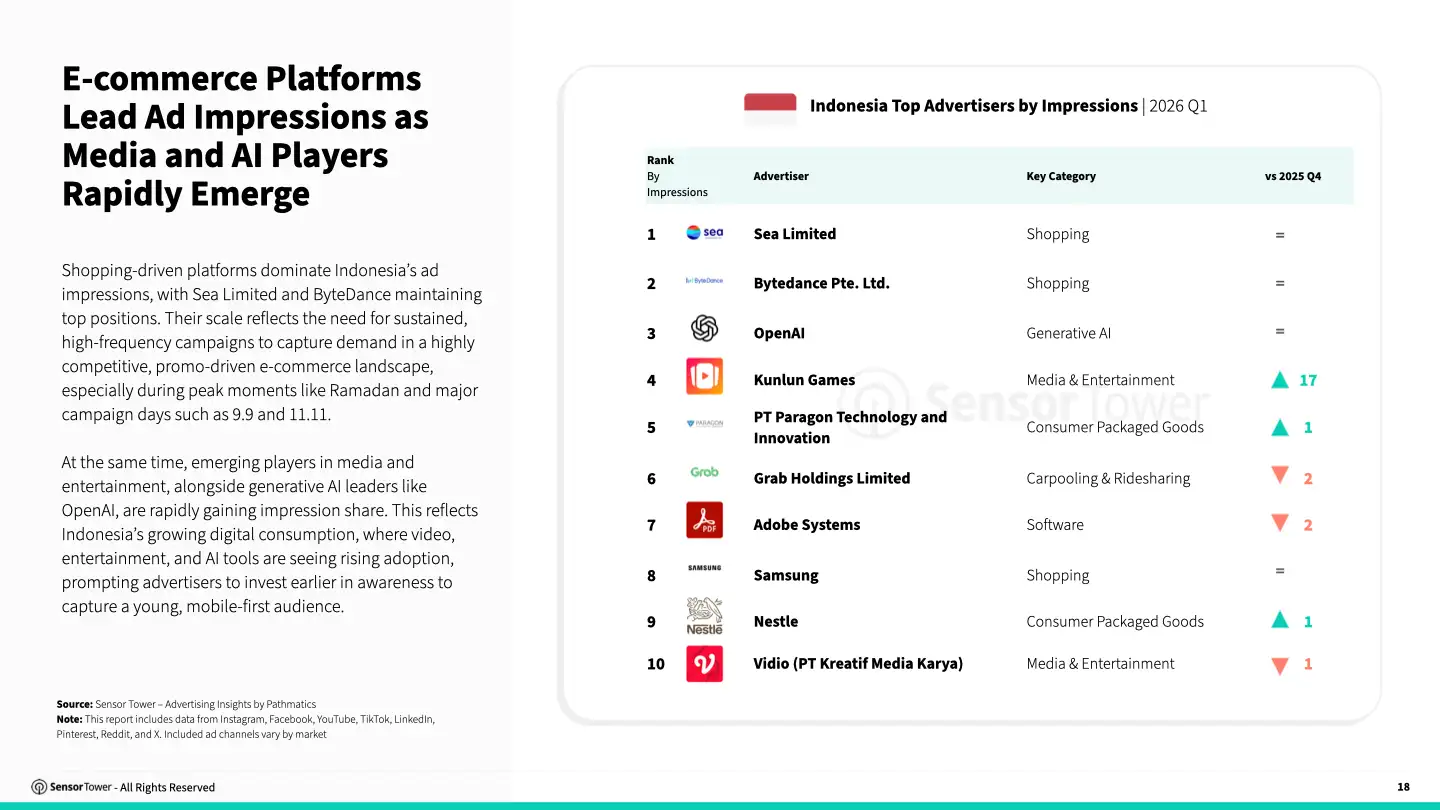
At the same time, emerging players in media and entertainment, alongside generative AI leaders like OpenAI, are rapidly gaining impression share. This reflects Indonesia’s growing digital consumption, where video, gaming, and AI tools are seeing rising adoption, prompting advertisers to invest earlier in awareness to capture a young, mobile-first audience.
Indonesia Ramadan Ad Activity Peaks Mid-Month, with Stronger Momentum in 2026
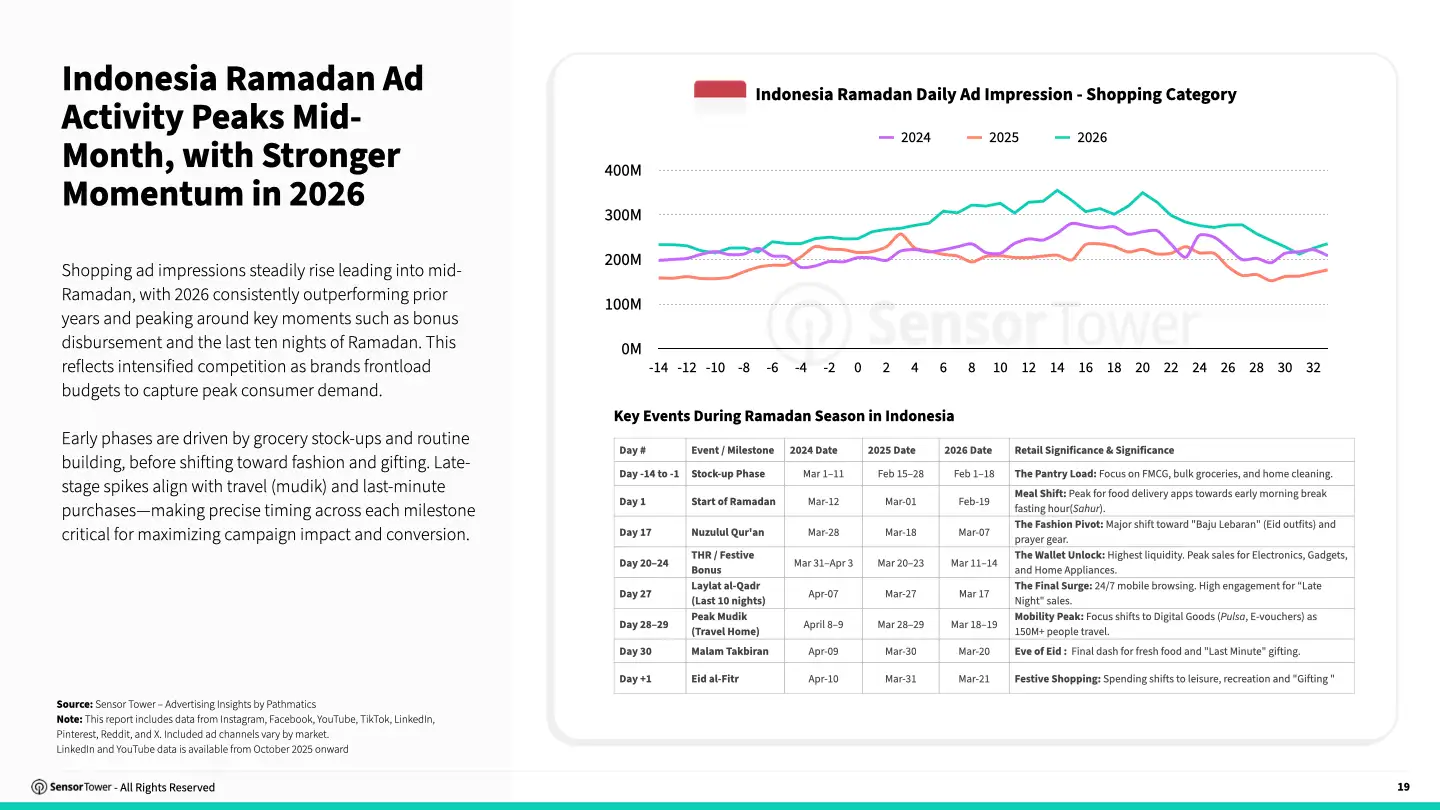
Shopping ad impressions steadily rise leading into mid-Ramadan, with 2026 consistently outperforming prior years and peaking around key moments such as bonus disbursement and the last ten nights of Ramadan. This reflects intensified competition as brands frontload budgets to capture peak consumer demand.
Early phases are driven by grocery stock-ups and routine building, before shifting toward fashion and gifting. Late-stage spikes align with travel (mudik) and last-minute purchases—making precise timing across each milestone critical for maximizing campaign impact and conversion.
Winning Through Localization: How Brands Leverage Cultural Relevance in Indonesia’s Digital Advertising
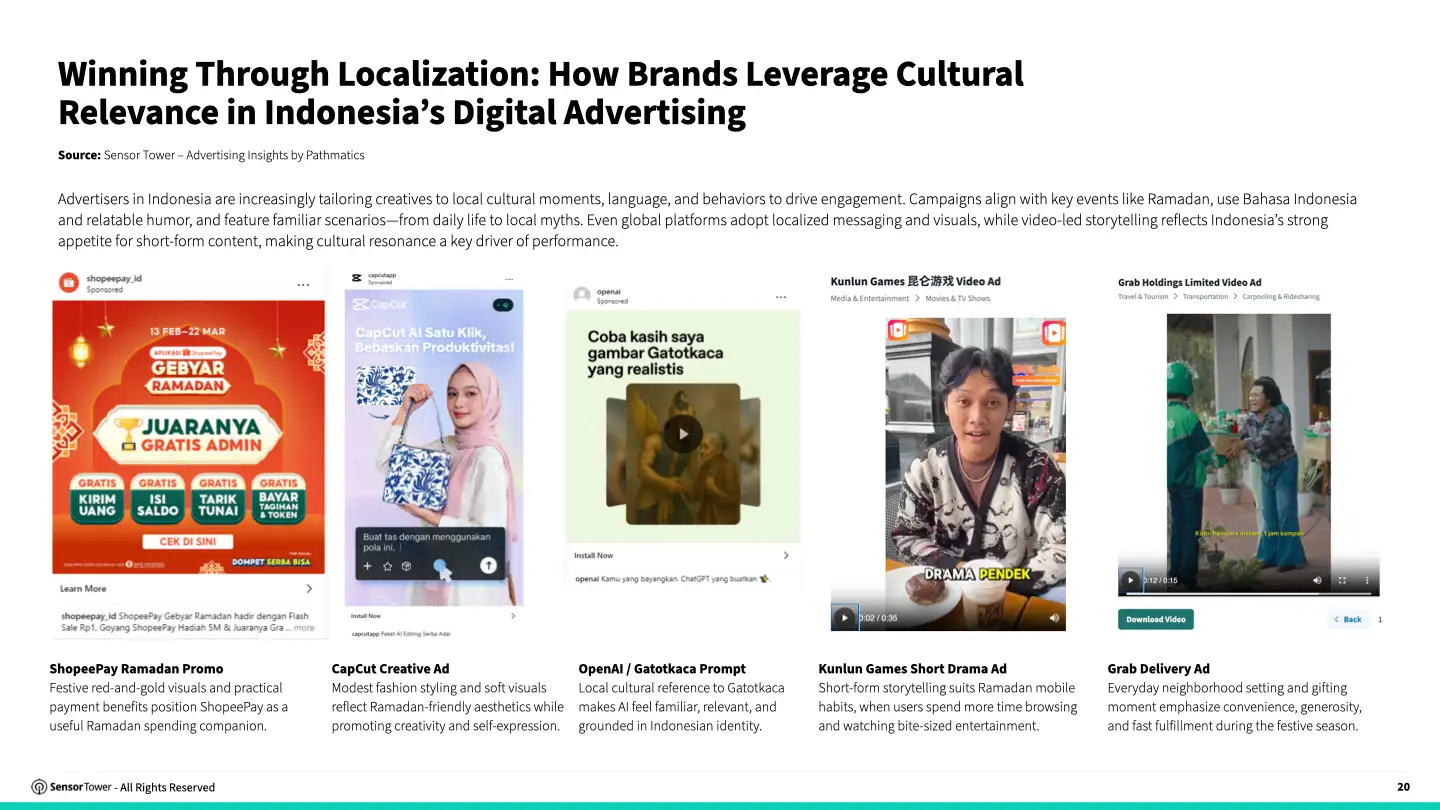
Advertisers in Indonesia are increasingly tailoring creatives to local cultural moments, language, and behaviors to drive engagement. Campaigns align with key events like Ramadan, use Bahasa Indonesia and relatable humor, and feature familiar scenarios—from daily life to local myths. Even global platforms adopt localized messaging and visuals, while video-led storytelling reflects Indonesia’s strong appetite for short-form content, making cultural resonance a key driver of performance.
Case Study: How Uniqlo Drives Growth Through App-First Strategy and Localized Campaigns
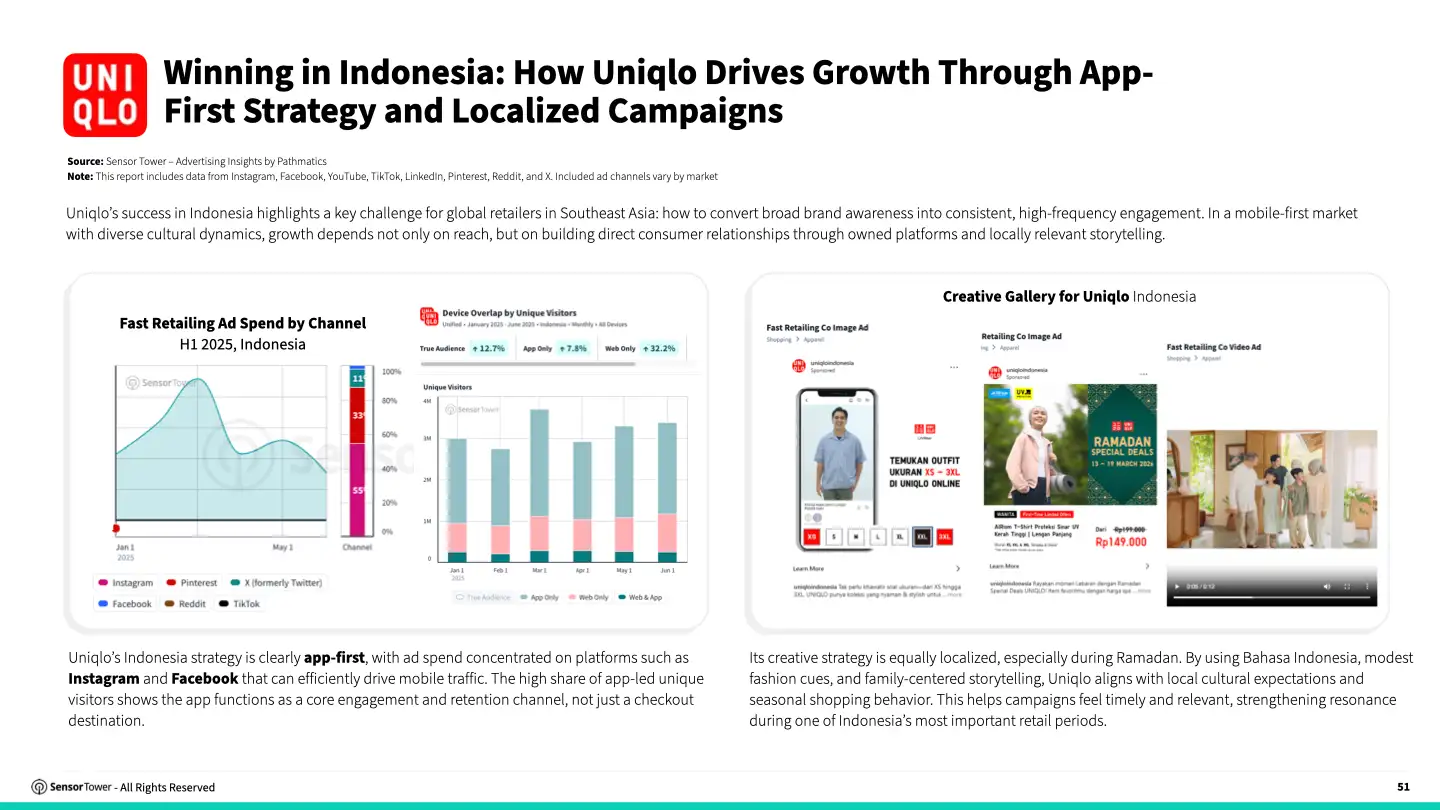
The report also explores how leading advertisers are adapting their strategies to Southeast Asia’s diverse local markets. In Indonesia, Uniqlo’s strategy is clearly app-first, with spend concentrated on platforms such as Instagram and Facebook to drive mobile traffic, while its Ramadan creatives use Bahasa Indonesia, modest fashion cues, and family-centered storytelling to improve cultural relevance.
The report also features deep dives into key Southeast Asian markets, including Vietnam, Thailand, Malaysia, the Philippines, and Singapore, alongside additional case studies across Temu, Vidio, Hyundai, and DramaBox. Together, these insights highlight how leading advertisers are using discount-led acquisition, audience targeting, always-on visibility, and localized creative strategies to drive growth across the region. For more insights, please download the full report.
Looking Ahead: Southeast Asia Enters a New Phase of Scale, Localization, and Precision
As Southeast Asia’s digital advertising market continues to expand, brands face a growing need to balance regional scale with local execution. Indonesia leads by impression volume and ad spend, but each market has distinct platform dynamics, geographic concentration, category mix, and seasonal behavior.
Momentum is likely to favor advertisers that combine disciplined media planning with culturally relevant, mobile-first creative strategies. From Ramadan and Tết to Songkran, Ber Months, and double-date shopping festivals, Southeast Asia’s biggest opportunities increasingly sit at the intersection of timing, localization, audience insight, and creative precision.
For a deeper look at digital ad spend trends, category performance, seasonal campaign activity, and the creative approaches shaping Southeast Asia’s digital advertising market, download the full report below.
