
Gaming Insights · Bryan Isagholian · May 2026
What Royal Match's Calendar Teaches About Live Ops in 2026
Most puzzle teams already know they need tournaments. The question isn't whether to run them: it's whether your calendar is built the way market leaders build theirs.
Looking for the full Live Ops Competitive Intelligence Playbook 2026, including live ops insights on puzzle, strategy, and casino? Download it here.
In our analysis of 12 top casual games, standard tournaments are table stakes: every title in the competitive set runs at least one, and the average game runs 2.5 distinct standard tournament formats. Sprint tournaments are close behind: 1.4 sprint-goal and 0.9 sprint-time formats per game on average. If you're below those numbers, you're likely behind genre expectations.
But parity isn't strategy. Royal Match, currently the #1 casual game by worldwide in-app purchase revenue, runs six standard tournament formats, and that still isn't the full story. The story is what happens when those tournaments sit on top of win-streak events, co-op challenges, milestone rewards, merge events, and a two-month album chase, all timed to peak on weekends.
That layering, not any single event type, is what separates genre parity from best-in-class execution. It's also the kind of insight competitive intelligence is supposed to produce: not a list of what competitors run, but a read on how the pieces fit together.
The parity baseline
We started with a focused question: are social events in match-swap puzzle games meeting genre expectations, and what does top-tier execution look like?
To answer it, we selected a 12-game competitive set using Sensor Tower Game IQ tags, revenue estimates, and audience overlap data: direct competitors, aspirational leaders, behavioral competitors, and up-and-comers. We then benchmarked live ops cadence and event mix using Playliner.
The tournament picture is clear:
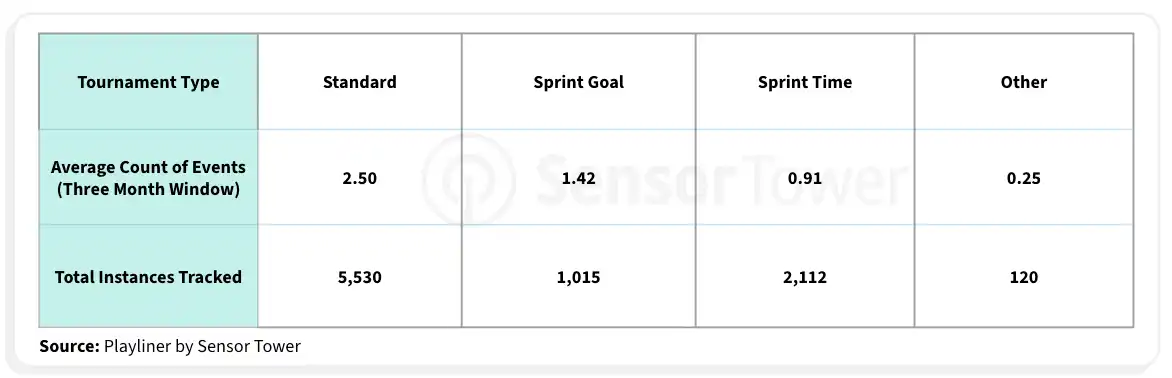
Standard tournaments dominate by volume. Playliner tracked more than 5,500 individual standard tournament instances across the set: far more than any other format. Sprint-time tournaments run at the fastest cadence, averaging 9.4 events per month per game.
The practical takeaway: a casual match-swap game should seriously consider running 2+ standard tournaments and 1+ sprint goal and sprint time tournaments to stay in line with genre norms.
Gaps still exist even among top performers. MONOPOLY GO! runs no sprint tournaments at all. Matchington Mansion has no sprint-goal formats. Gossip Harbor, one of the fastest-growing casual games in recent years, runs six sprint-goal tournaments but zero sprint-time formats. Table stakes doesn't mean everyone has everything, but it does mean the baseline keeps rising.
Benchmarking answers the first competitive intelligence question: Are we behind? For many match-swap games, the answer on tournaments is increasingly yes if you're running fewer than two standard formats and at least one sprint variant.
But benchmarking only tells you what to copy. It doesn't tell you how to assemble the pieces.
What Royal Match actually does Benchmark tables tell you the what. A tear-down tells you the why.
Royal Match is a live ops-driven monetization game. Its in-app purchase revenue spikes on weekends: driven by an increase in monetization and conversion caused by events, not by surges in DAU, downloads, or time spent. The calendar is engineered for that outcome.
Zoom into a single week during the Culinary Collection album event, and three distinct layers become visible:
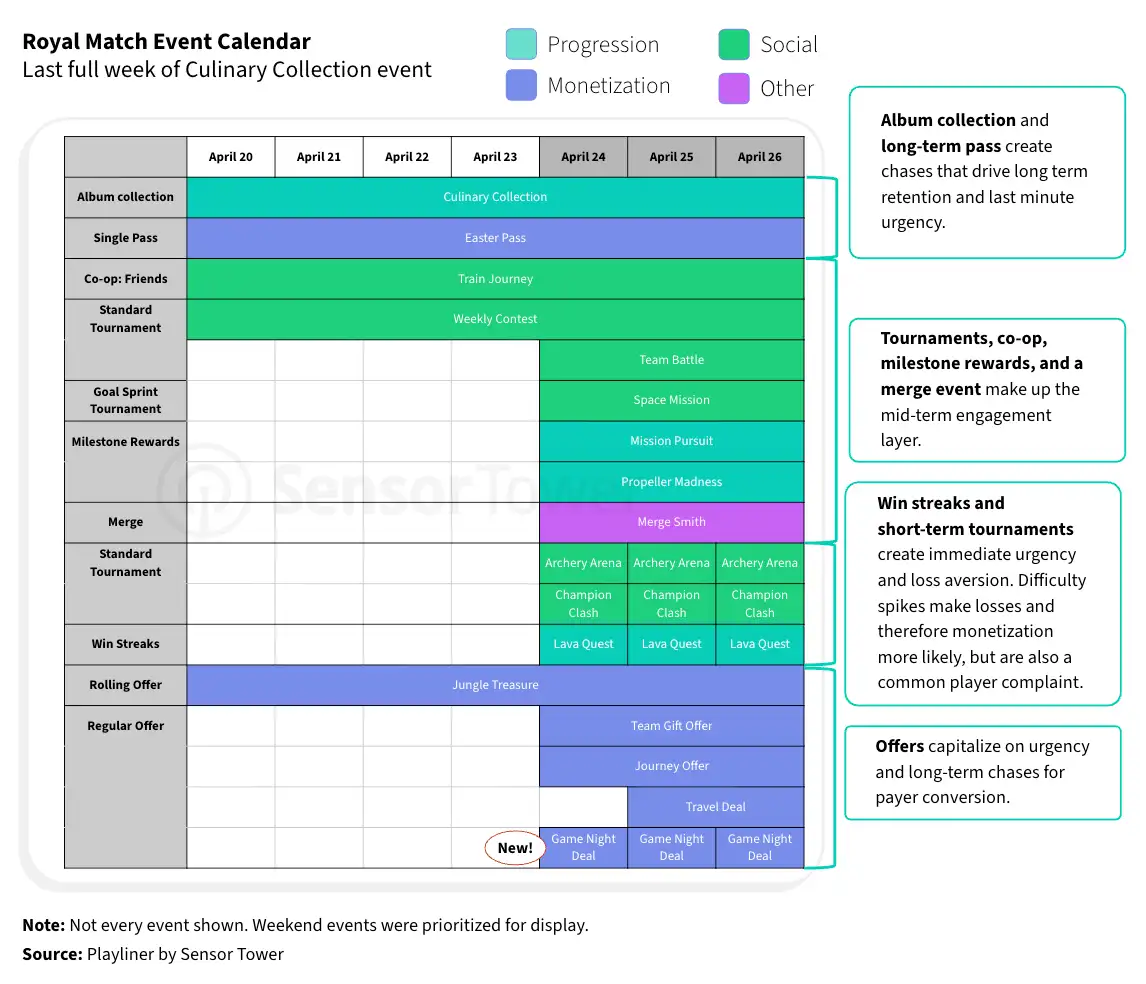
Short-term: urgency and loss aversion. Win-streak events like Lava Quest create daily pressure — complete seven levels in a row or lose your progress. Sprint tournaments like Space Mission and Propeller Madness add session-length urgency. Rolling offers like Jungle Treasure sit alongside them, converting players who are already under event pressure. These events don't build long-term progression. They create reasons to play today, and reasons to spend when a streak or sprint is about to break.
Mid-term: social engagement and competition. Weekly Contest, Archery Arena, Team Battle, and Champion Clash anchor the weekly rhythm. Friends Train Journey adds a co-op layer. Mission Pursuit delivers milestone rewards. Merge Smith extends the mid-term loop into a secondary progression system. Tournaments and co-op events sit here — long enough to drive return visits across the week, short enough to feel winnable. Many are timed to weekends, where Royal Match's revenue spikes concentrate.
Long-term: retention chases. Culinary Collection runs for two months. The Easter Pass provides a seasonal progression rail. Album collections and passes create the backbone. Everything else orbits them.
The competitive intelligence insight isn't "Royal Match runs Lava Quest." It's "Royal Match runs Lava Quest in concert with an integrated system of events, where collections set the stage, social events give achievable mid-term goals, Lava Quest amplifies loss aversion, and offers drive targeted conversion on demand built up by the rest of the calendar."
Let's zoom in on another example.
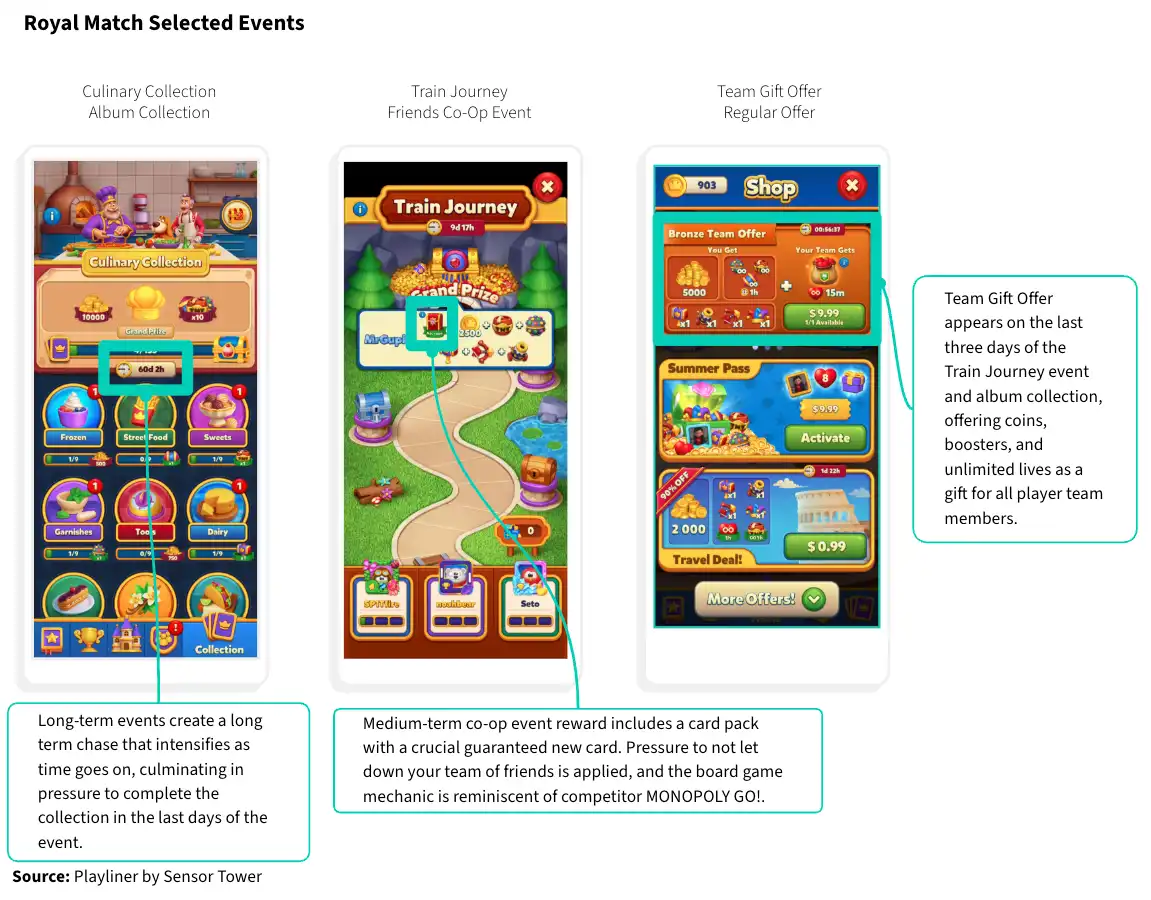
Card packs are a highly desirable reward throughout the album cycle. As the event nears its end and duplicates become more common, packs that guarantee a new card become increasingly valuable. Train Journey, a co-op friends event, offers one of those guaranteed new card packs, but only as the event's grand prize. Engagement becomes something you do for your team, not just for yourself. Then, on the last three days of both Train Journey and Culinary Collection, a Team Gift Offer appears: coins, boosters, and unlimited lives as a gift for all team members.
Events aren't independent. They're sequenced to intensify pressure as a long-term chase nears completion. Copy the event type, and you miss the architecture.
There's a tension worth acknowledging. Royal Match's difficulty-driven monetization is also its most common player complaint. The calendar is effective precisely because events intersect with moments of friction. Understanding that tradeoff is part of reading a competitor calendar honestly: not just cataloguing what works, but noting what it costs.
Go deeper
The 2026 Live Ops Competitive Intelligence Playbook walks through this process across three genres, puzzle social events, strategy milestone rewards, and casino offer design, with full benchmark tables, tear-downs, and prioritization frameworks.
If you're building or refining your live ops calendar, the question isn't whether to watch competitors. You already are. The question is whether you're extracting decisions from what you see: or just adding another tab to the spreadsheet.
Download the Live Ops Competitive Intelligence Playbook 2026 here. Inside you'll find:
More puzzle and Royal Match live ops insights.
Strategy and Casino case studies, with Kingshot and Lightning Links tear downs.
The competitive intelligence process framework.
