
Digital Advertising Insights · Donny Kristianto · February 2026
State of India Mobile App Market 2026
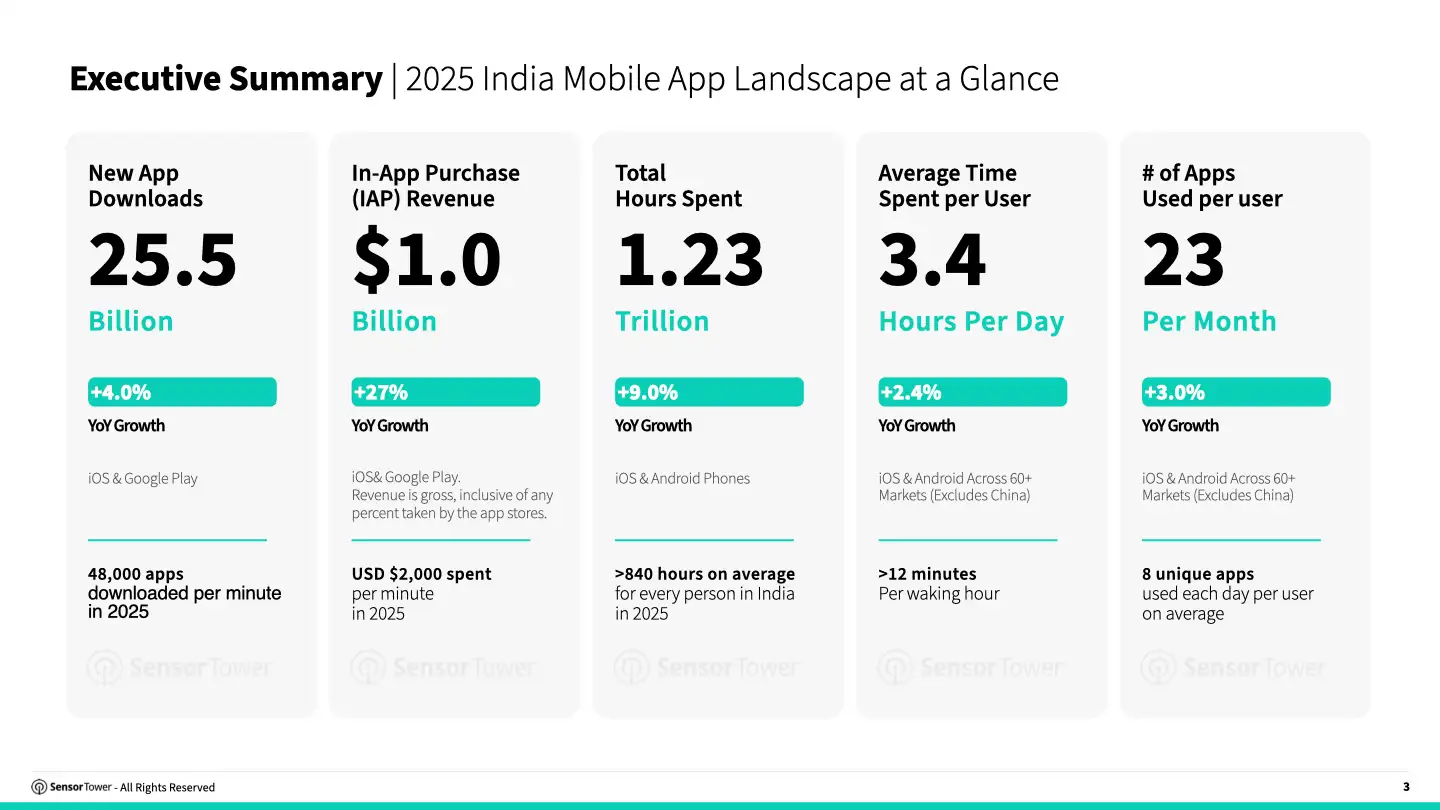
India is one of the world’s most dynamic mobile-first markets—defined not just by scale, but by how new behaviors form and spread across apps. The State of India Mobile App Market 2026 report by Sensor Tower explores how emerging categories are finding growth by embedding into everyday routines, reshaping engagement across the country.
India remains the world’s largest mobile market, generating around 25 billion downloads annually. Growth stabilized in 2025 as the market matured, with volumes expected to remain resilient and positive into 2026—supported by sustained usage, retention, and repeat engagement across essential, habit-forming apps.
With scale firmly in place, India has entered a monetization-led phase. Annual IAP revenue surpassed $1 billion in 2025 and is projected to reach $1.25 billion by end of 2026. Growth is increasingly driven by premium services, subscriptions, and higher-value users, with non-gaming apps accounting for a rising share of total consumer spend.
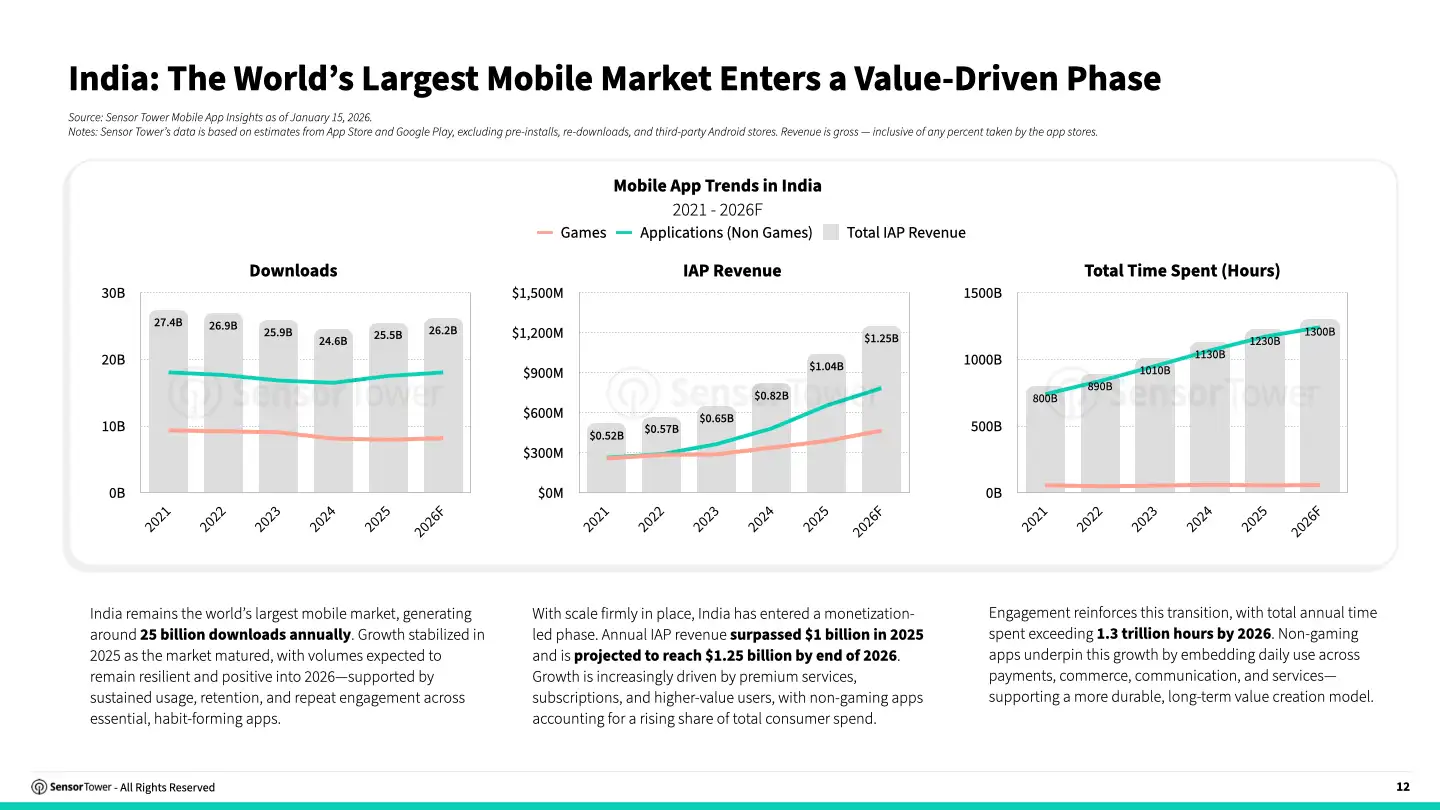
Engagement reinforces this transition, with total annual time spent exceeding 1.3 trillion hours by 2026. Non-gaming apps underpin this growth by embedding daily use across payments, commerce, communication, and services—supporting a more durable, long-term value creation model.
Note: The download data in this report are based on estimated downloads from the App Store and Google Play, excluding pre-installs, re-downloads, and downloads from third-party Android marketplaces. For more insights, please click the button below to view the full report for free.
Which Categories are Driving Downloads Growth In India? Utility-led Downloads as Generative AI and Emerging Categories Drive Growth
India’s mobile app downloads remain anchored by Utilities and Productivity, which account for over one-third of total installs in 2025. Media & Entertainment and Social Media continue to contribute meaningful volume, while Shopping, Jobs & Education, and Financial Services remain important to overall demand. This mix reflects a mature market where essential, everyday apps sustain scale as category breadth expands.
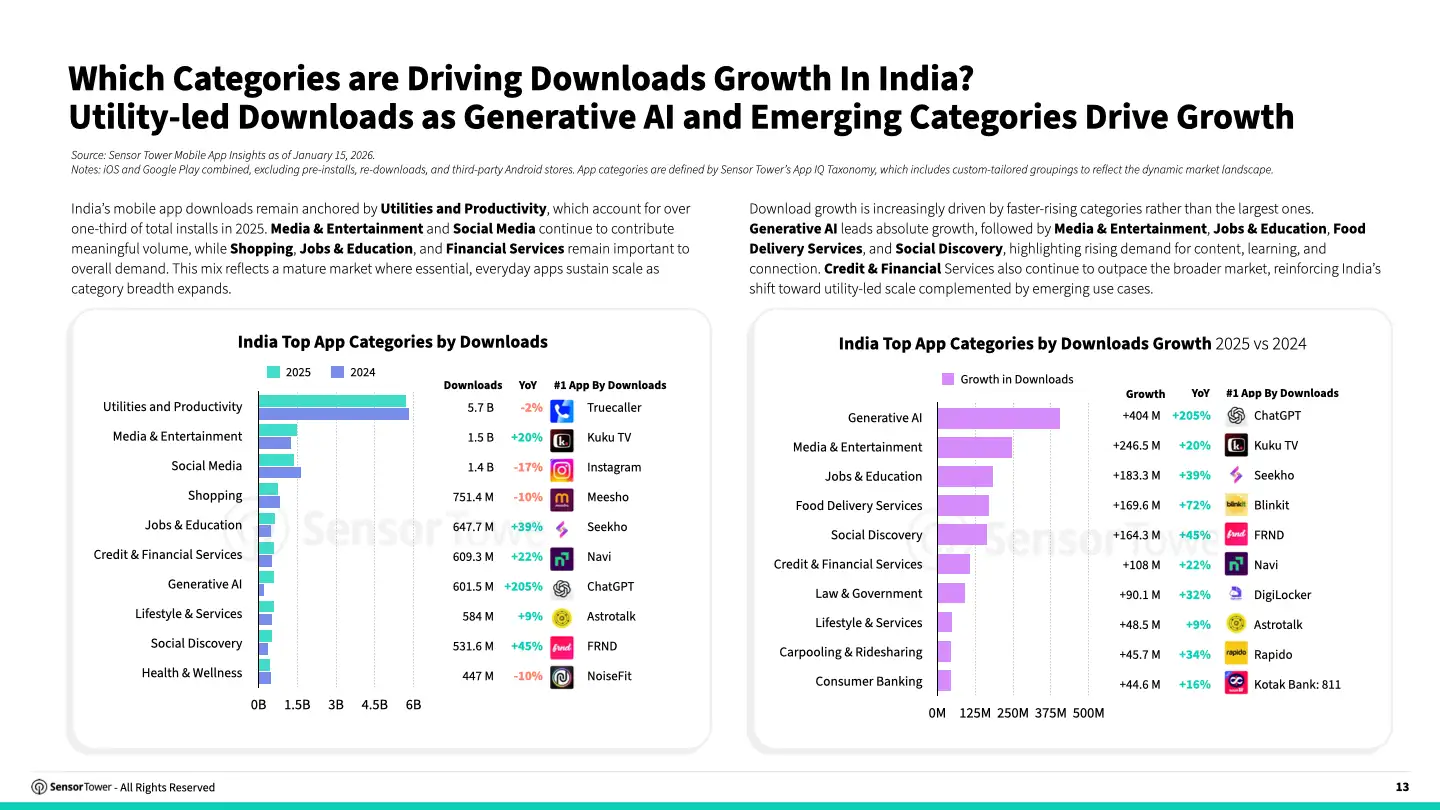
Download growth is increasingly driven by faster-rising categories rather than the largest ones. Generative AI leads absolute growth, followed by Media & Entertainment, Jobs & Education, Food Delivery Services, and Social Discovery, highlighting rising demand for content, learning, and connection. Credit & Financial Services also continue to outpace the broader market, reinforcing India’s shift toward utility-led scale complemented by emerging use cases.
India’s Shopping Apps: Engagement Strengthens as Consumer Behavior Evolves
Downloads across general shopping and e-commerce apps moderated further in 2025, declining modestly versus 2024 as acquisition cooled among broad, multi-category retail platforms. In contrast, Apparel and Beauty Retail proved more resilient, with both categories continuing to post positive growth—highlighting sustained demand for specialized, category-led shopping experiences.
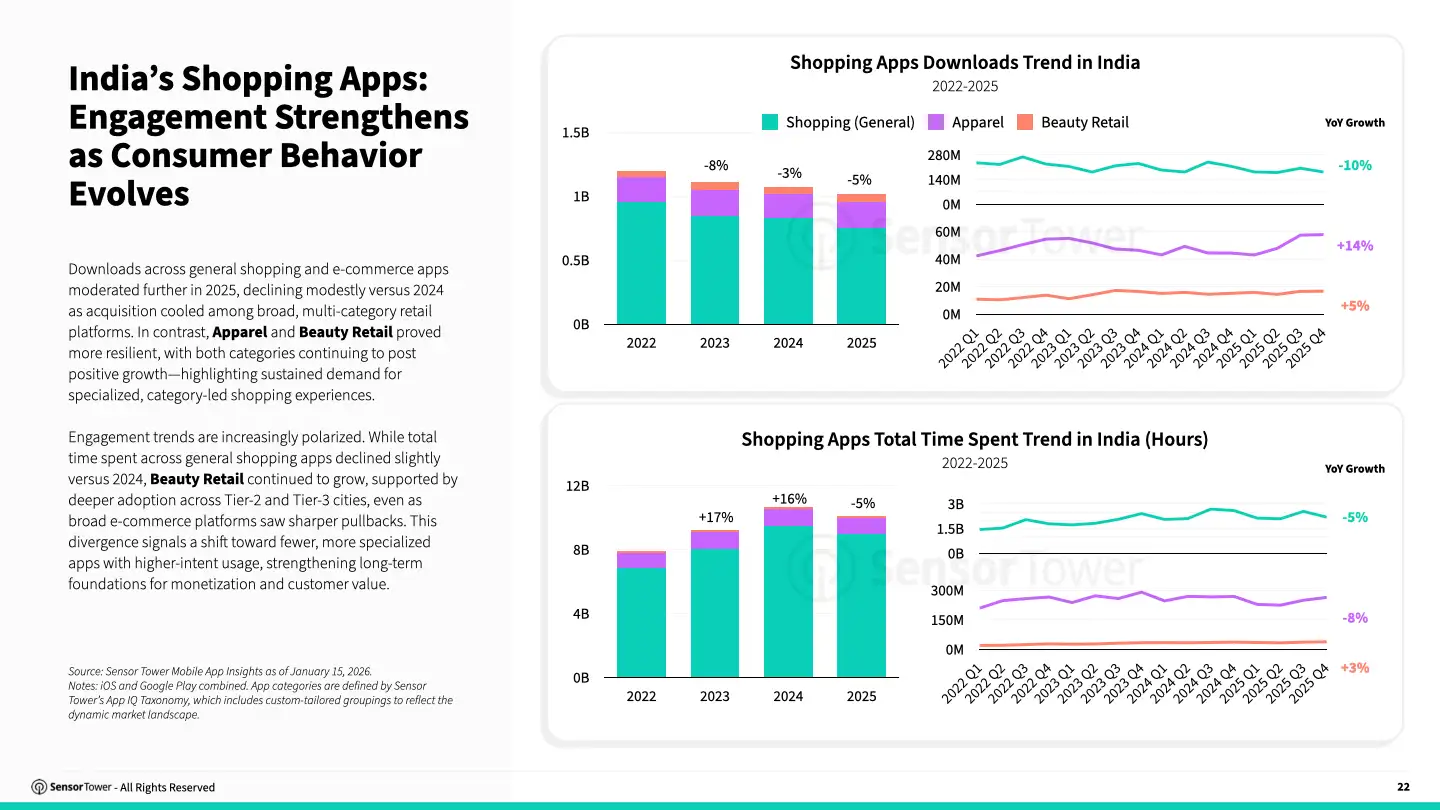
Engagement trends are increasingly polarized. While total time spent across general shopping apps declined slightly versus 2024, Beauty Retail continued to grow, supported by deeper adoption across Tier-2 and Tier-3 cities, even as broad e-commerce platforms saw sharper pullbacks. This divergence signals a shift toward fewer, more specialized apps with higher-intent usage, strengthening long-term foundations for monetization and customer value.
Apparel and Beauty Retail Emerge as Key Growth Drivers in India’s Shopping Apps
India’s core shopping apps remain largely stable, reflecting a mature, highly competitive market where incumbents such as Meesho, Flipkart, and Amazon continue to defend scale through pricing, assortment breadth, and logistics rather than rapid user expansion.
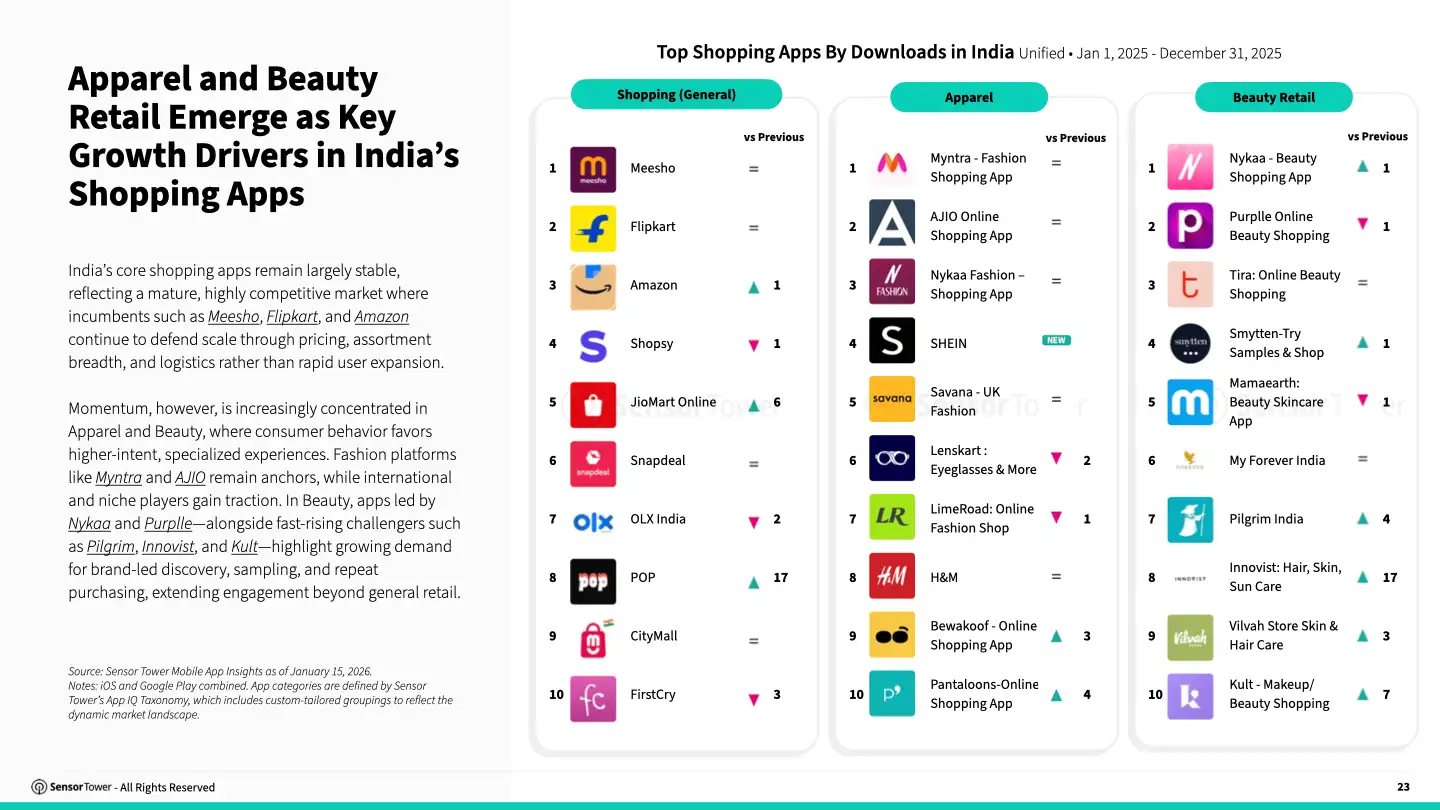
Momentum, however, is increasingly concentrated in Apparel and Beauty, where consumer behavior favors higher-intent, specialized experiences. Fashion platforms like Myntra and AJIO remain anchors, while international and niche players gain traction. In Beauty, apps led by Nykaa and Purplle—alongside fast-rising challengers such as Pilgrim, Innovist, and Kult—highlight growing demand for brand-led discovery, sampling, and repeat purchasing, extending engagement beyond general retail.
Tier-2 and Tier-3 Cities Power the Next Phase of Beauty and Fashion Growth
Beauty and fashion apps are increasingly drawing growth from Tier-2 and Tier-3 cities, where adoption is accelerating faster than in India’s largest metros. For several leading platforms, regional users now account for over one-third of total active users—signaling a structural shift in where engagement and scale are being built.
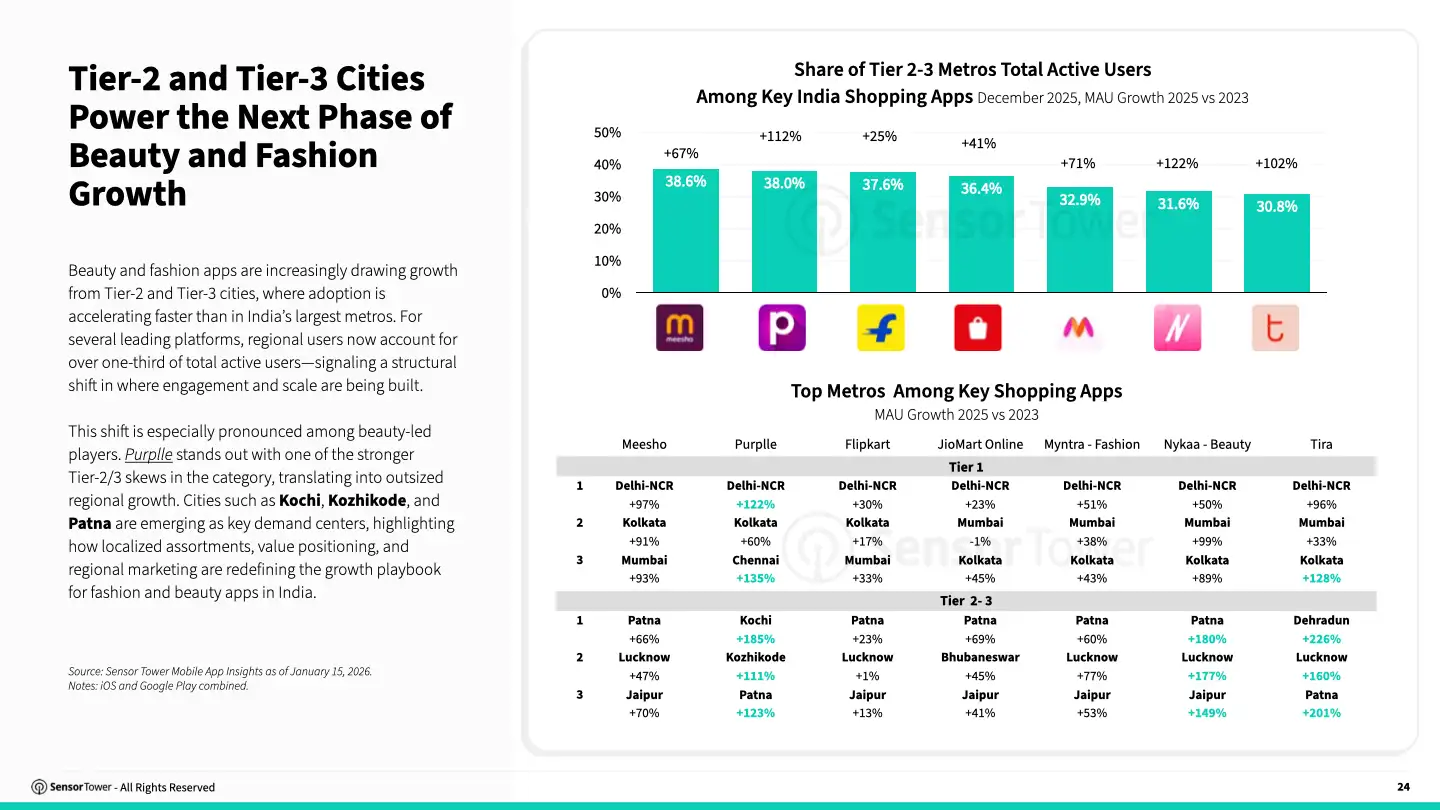
This shift is especially pronounced among beauty-led players. Purplle stands out with one of the stronger Tier-2/3 skews in the category, translating into outsized regional growth. Cities such as Kochi, Kozhikode, and Patna are emerging as key demand centers, highlighting how localized assortments, value positioning, and regional marketing are redefining the growth playbook for fashion and beauty apps in India.
India’s Quick Commerce Race: From Early Disruptors to Platform Convergence
India’s quick commerce landscape was shaped first by early digital grocery pioneers such as BigBasket and Grofers (rebranded as Blinkit in 2021), which built trust and habitual ordering for daily essentials. Though not designed for ultra-fast delivery, these platforms established the reliability and usage patterns that later enabled frequent, on-demand grocery consumption.
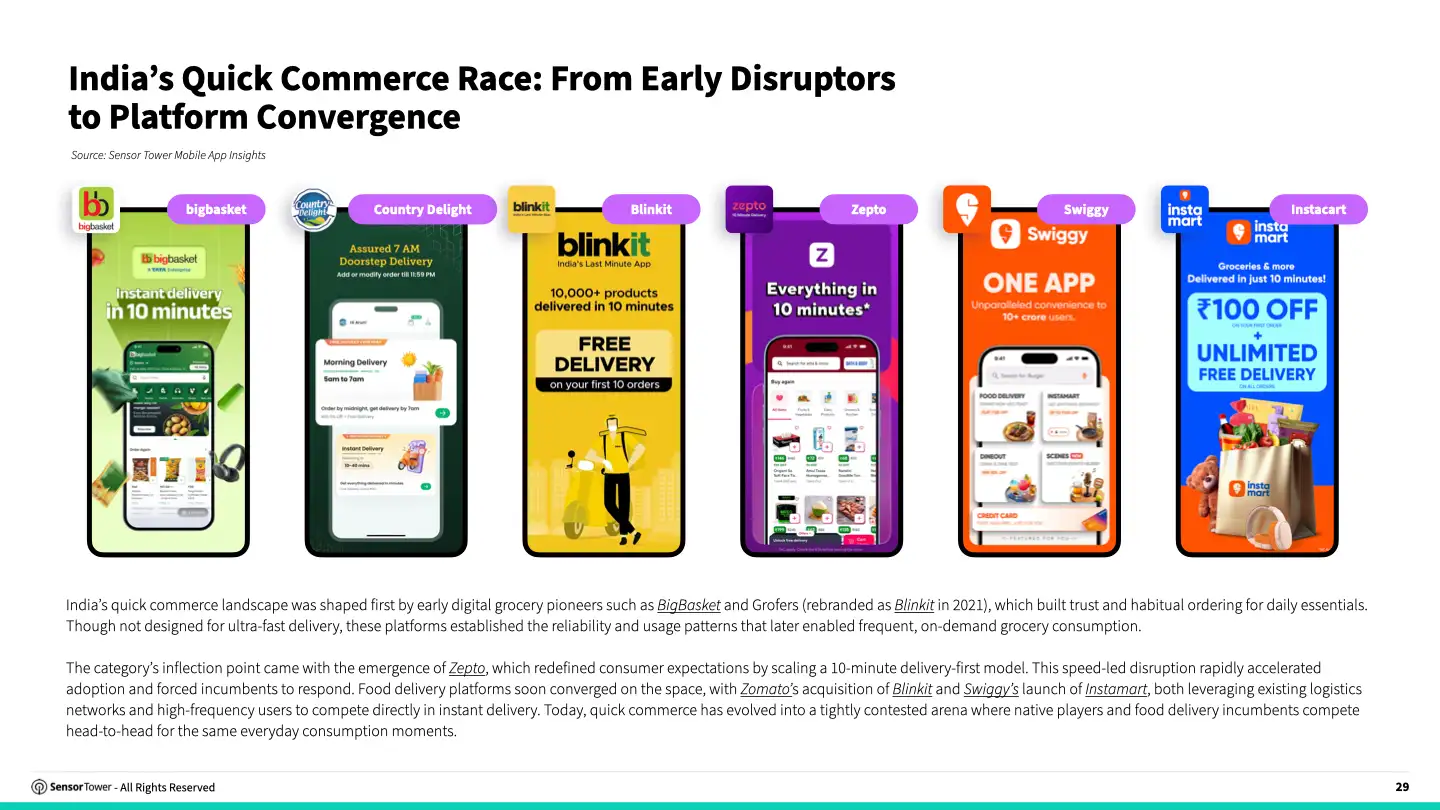
The category’s inflection point came with the emergence of Zepto, which redefined consumer expectations by scaling a 10-minute delivery-first model. This speed-led disruption rapidly accelerated adoption and forced incumbents to respond. Food delivery platforms soon converged on the space, with Zomato’s acquisition of Blinkit and Swiggy’s launch of Instamart, both leveraging existing logistics networks and high-frequency users to compete directly in instant delivery. Today, quick commerce has evolved into a tightly contested arena where native players and food delivery incumbents compete head-to-head for the same everyday consumption moments.
India’s Finances Apps Shift From Wallet-Led Scale to Deeper Financial Engagement
Financial services app downloads in India continued to grow in 2025, but at a moderating pace versus earlier years. Growth has increasingly shifted away from Digital Wallets & P2P Payments, which saw softer momentum, toward Credit & Financial Services and Consumer Banking, reflecting rising demand for lending, credit access, and full-service mobile banking.
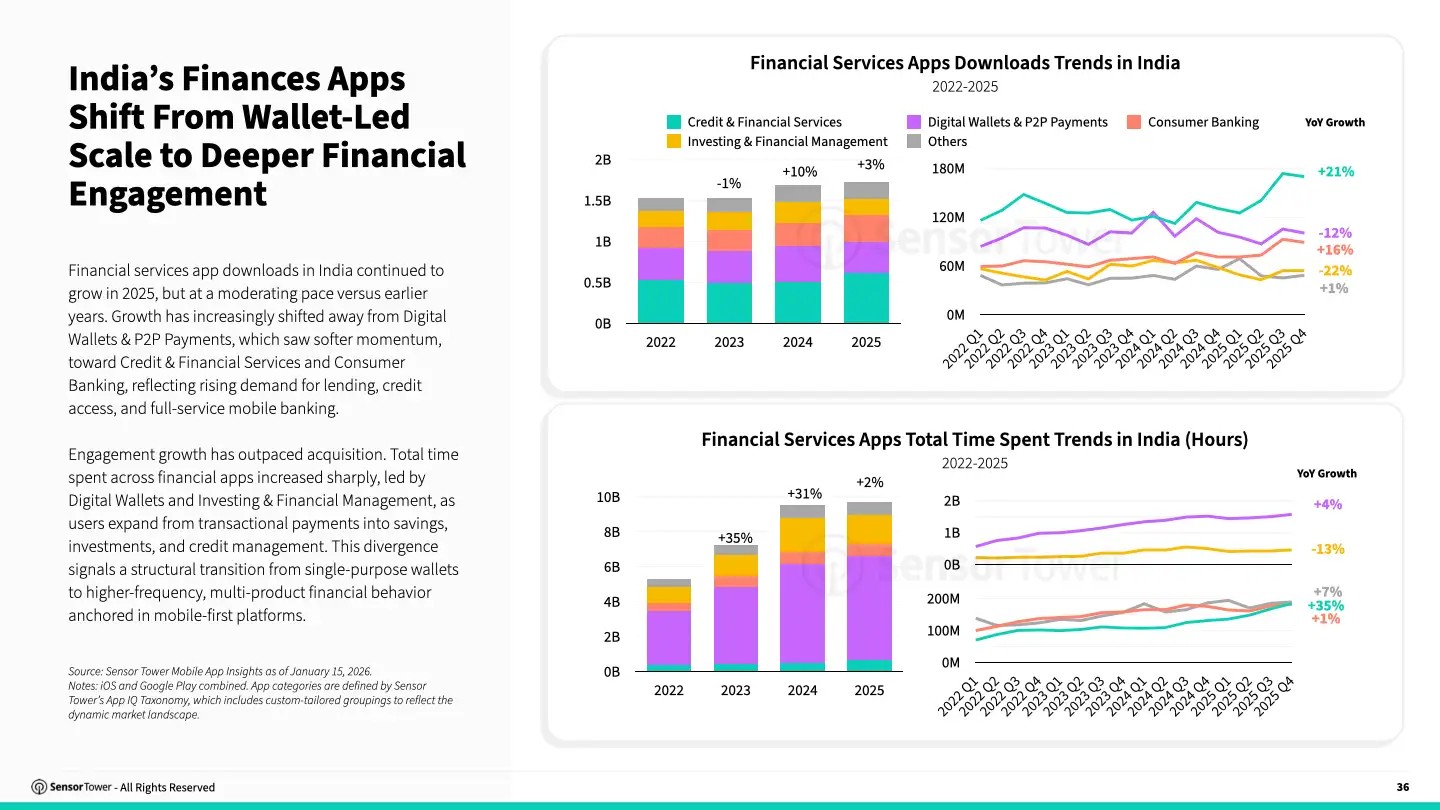
Engagement growth has outpaced acquisition. Total time spent across financial apps increased sharply, led by Digital Wallets and Investing & Financial Management, as users expand from transactional payments into savings, investments, and credit management. This divergence signals a structural transition from single-purpose wallets to higher-frequency, multi-product financial behavior anchored in mobile-first platforms.
Banks Rebuild the Front Door by Adopting Fintech-Style Experiences
After years of ceding engagement to fintechs, Indian banks are rebuilding their mobile front doors with clearer, consumer-first design. Recent app revamps from Kotak 811, HDFC, SBI, and ICICI emphasize simplified dashboards, faster payments, card-style navigation, integrated bill pay, and personalized shortcuts—mirroring fintech norms around speed, clarity, and everyday utility rather than legacy banking workflows.
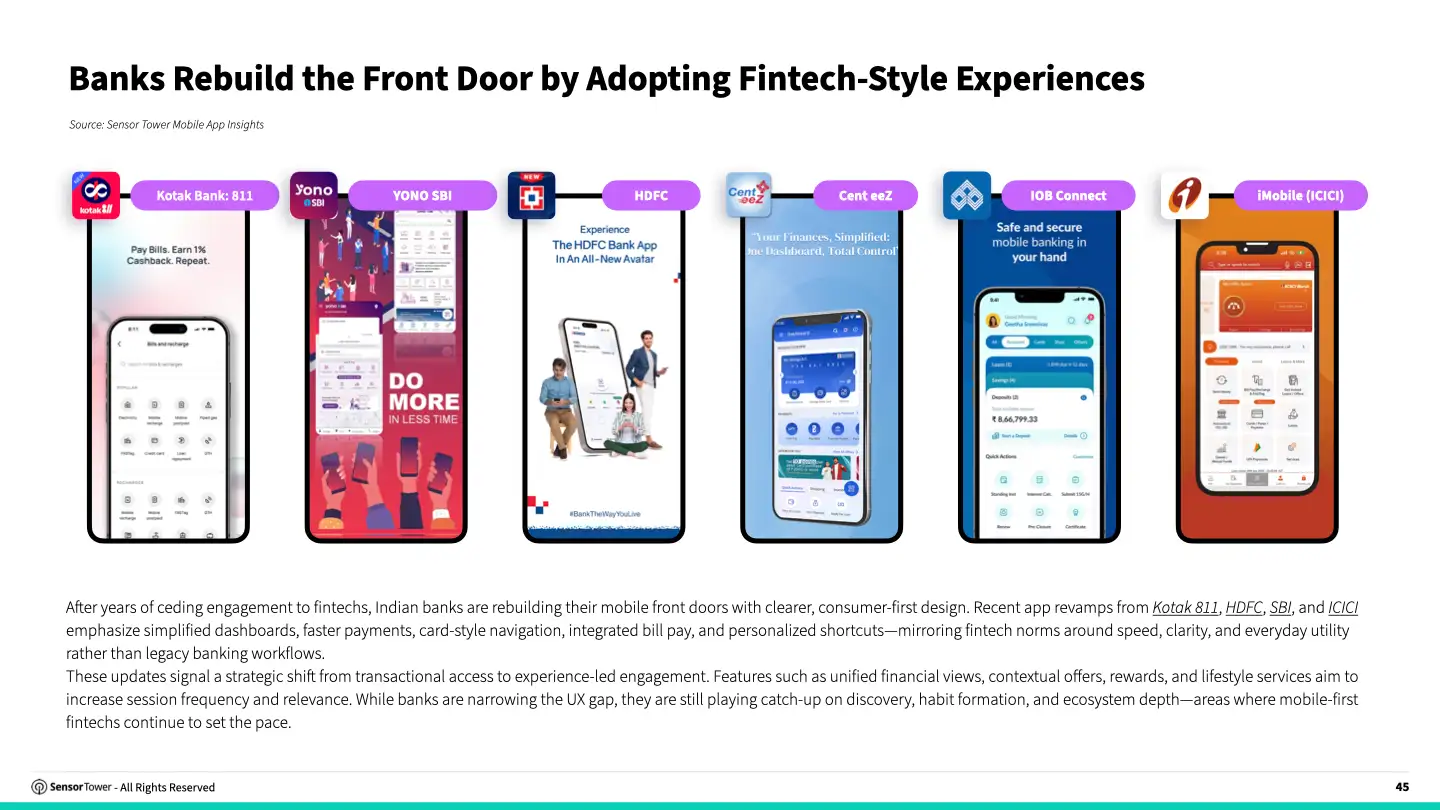
These updates signal a strategic shift from transactional access to experience-led engagement. Features such as unified financial views, contextual offers, rewards, and lifestyle services aim to increase session frequency and relevance. While banks are narrowing the UX gap, they are still playing catch-up on discovery, habit formation, and ecosystem depth—areas where mobile-first fintechs continue to set the pace.
Entertainment Apps: Short-Form Content Redefines Mobile Consumption
India’s short-drama category has scaled rapidly as users gravitate toward serialized, bite-sized storytelling designed for frequent, mobile consumption. Global leaders like DramaBox have set the pace, proving demand for vertical-video dramas with high release velocity and cliffhanger-driven formats that encourage daily return behavior and sustained engagement.
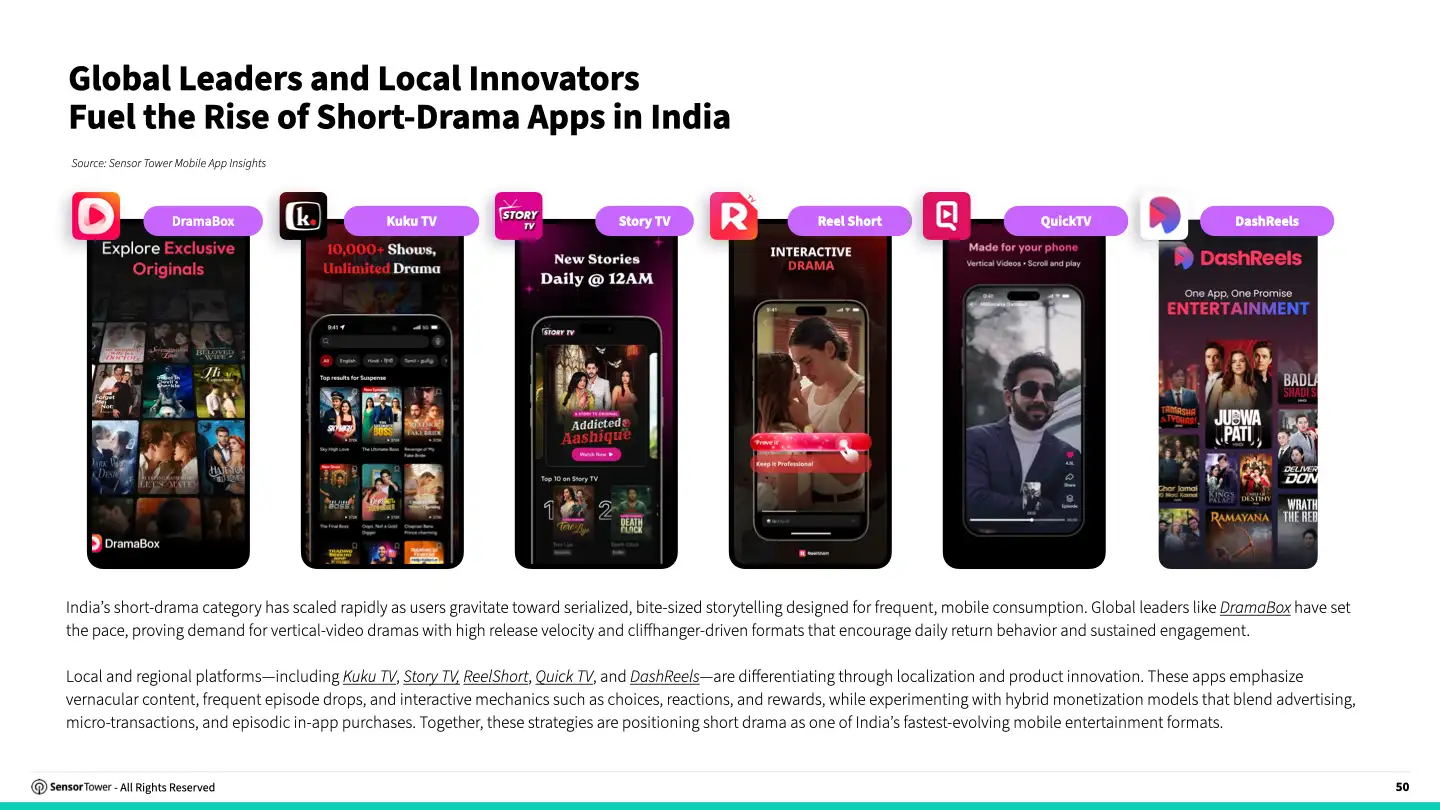
Local and regional platforms—including Kuku TV, Story TV, ReelShort, Quick TV, and DashReels—are differentiating through localization and product innovation. These apps emphasize vernacular content, frequent episode drops, and interactive mechanics such as choices, reactions, and rewards, while experimenting with hybrid monetization models that blend advertising, micro-transactions, and episodic in-app purchases. Together, these strategies are positioning short drama as one of India’s fastest-evolving mobile entertainment formats.
Ride-Hailing Leaders Maintain Scale as Growth Shifts to Drivers and Regional Mobility
India’s ride-hailing market is now led by Rapido, which has overtaken established players like Uber and Ola by scaling bike taxis and autos across urban and regional markets. Stable rankings year over year reflect a mature category, but Rapido’s lead highlights how affordability and everyday use cases are reshaping mobility leadership.
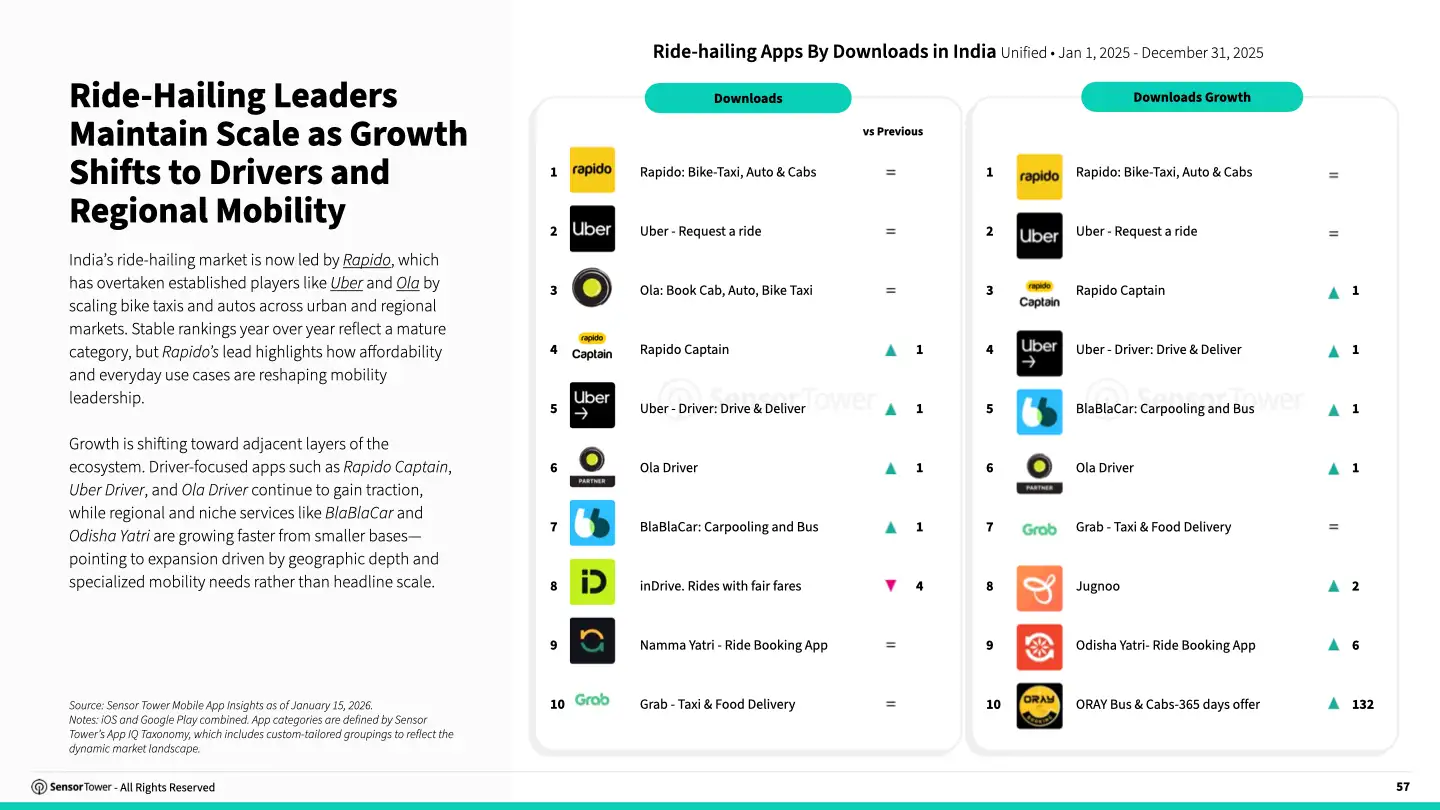
Growth is shifting toward adjacent layers of the ecosystem. Driver-focused apps such as Rapido Captain, Uber Driver, and Ola Driver continue to gain traction, while regional and niche services like BlaBlaCar and Odisha Yatri are growing faster from smaller bases—pointing to expansion driven by geographic depth and specialized mobility needs rather than headline scale.
Looking Ahead: The Next Phase of India’s Mobile App Economy
As India’s mobile app ecosystem continues to mature, the challenge for app publishers will be to move beyond scale toward sustained, habit-driven engagement. With a vast mobile-first user base, growth is increasingly shaped by how effectively apps embed into daily routines—through speed, utility, trust, and relevance—rather than by acquisition alone.
Emerging categories such as quick commerce, social discovery, short-form entertainment, and AI-powered services highlight where incremental growth is forming, while established platforms are redefining themselves to defend engagement and relevance. For a deeper view into category trends, leading apps, and the strategies driving durable growth, download the full report below.

Written by: Donny Kristianto , Principal Market Insights Manager
Date: February 2026